
IPFLY Review 2026: 90M+ Residential Proxies Tested
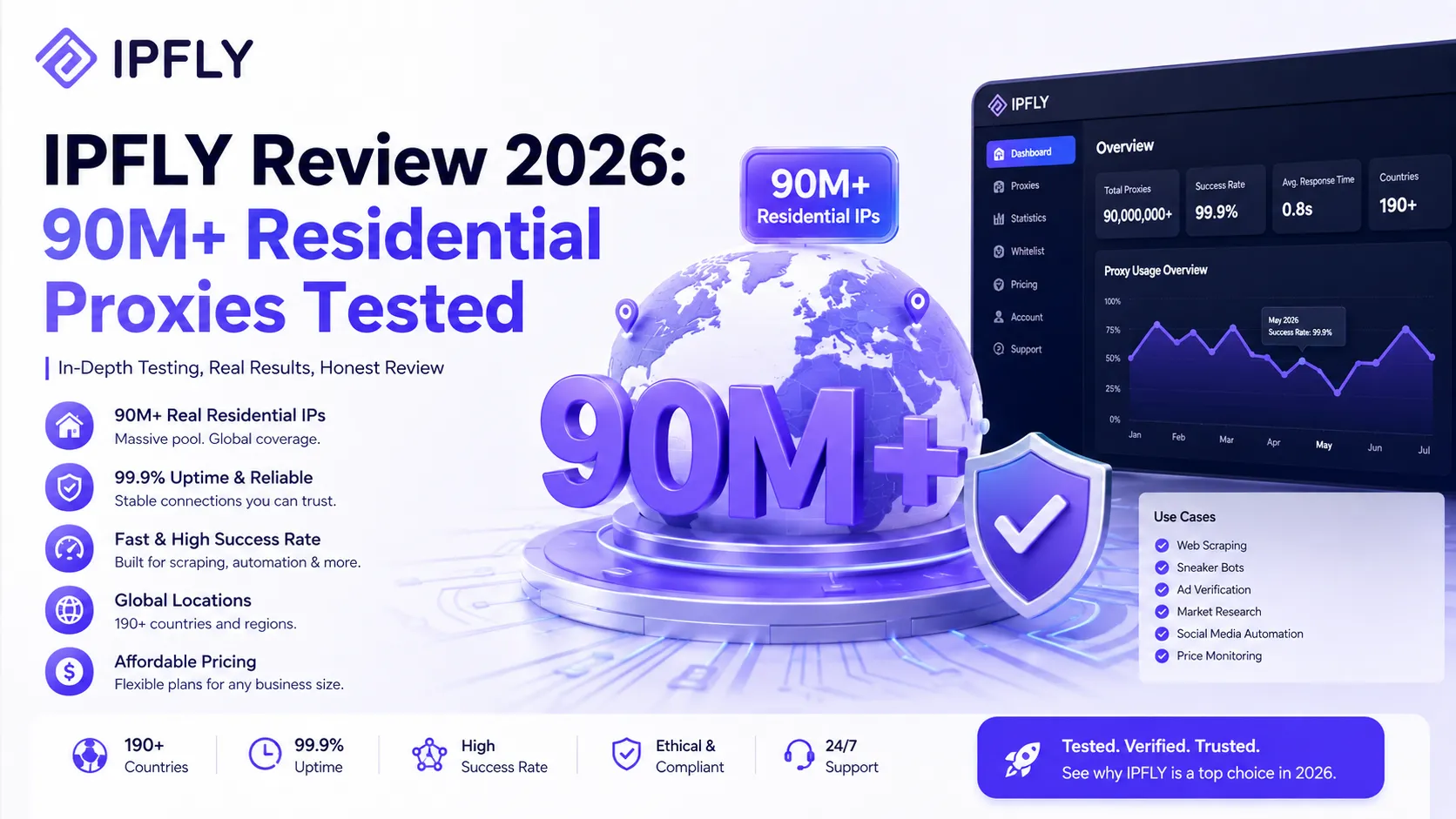
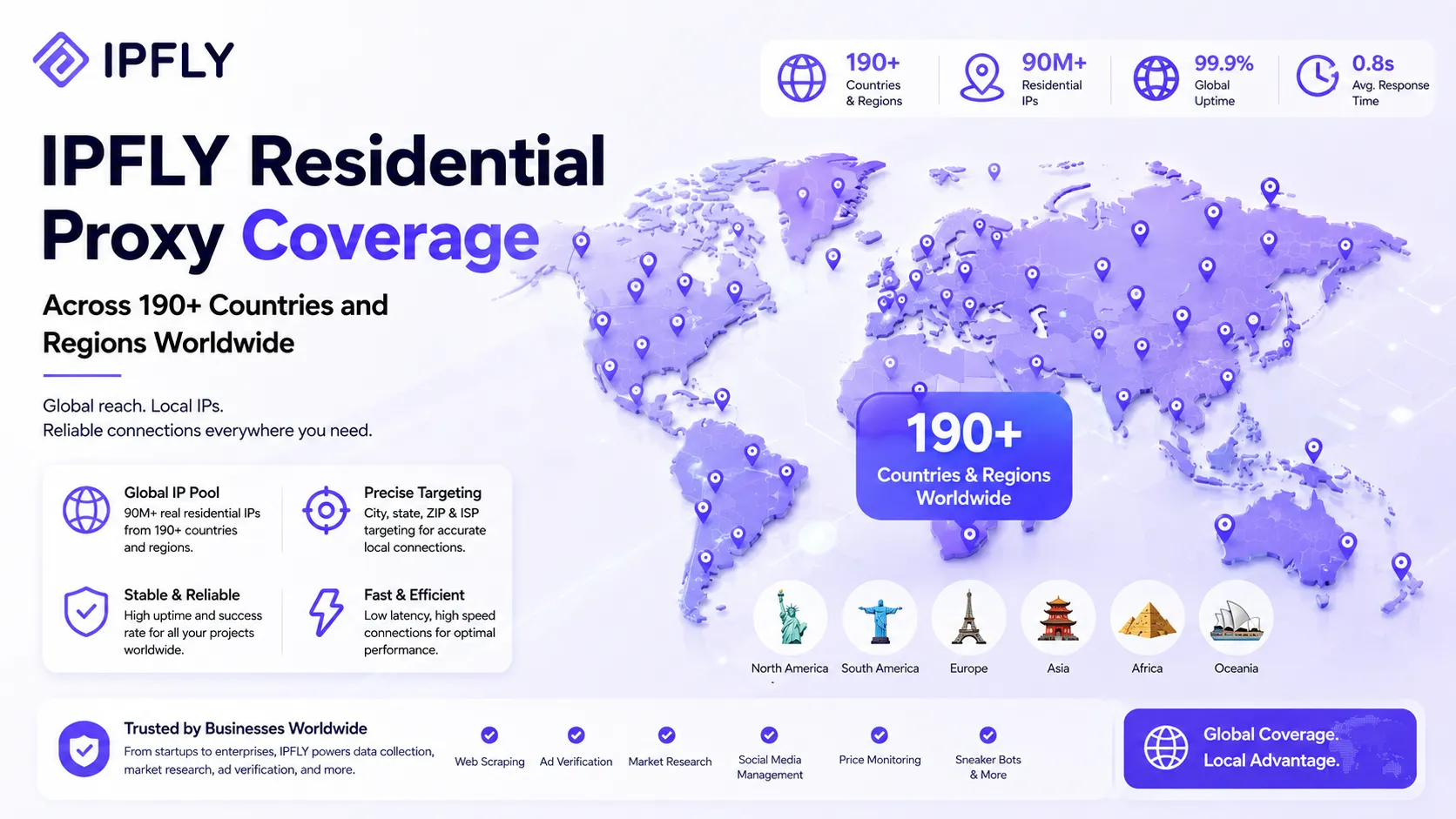
Ninety million residential IPs, three proxy types under one dashboard, and Alipay accepted at checkout. That's the shape of IPFLY, a global proxy network selling rotating residential, static ISP, and dedicated datacenter proxies plus four scraper APIs (Browser, Unblocker, SERP, Media File) to a worldwide buyer base. After walking through the three product pages, the pricing tables for each proxy type, and the solutions bundles for ad verification and web scraping, the operator profile lands between the enterprise names and the aggressive per-GB budget players. IPFLY publishes coverage across 190+ countries, a 0.6-second average response time on residential IPs, and a 99.9% success rate. The pricing pages back those claims with per-tier commitments rather than vague "contact sales" walls, which is the first honesty check any proxy shopper should run. Whether that combination fits your workload is what this review is here to answer.

The Transparency score reflects a specific strength in the IPFLY story: pricing is public down to the per-plan gigabyte or per-IP number (rare in this market), and the residential pool size (90M+) is published on the homepage. Buyers who need enterprise procurement paperwork should still ask for it before signing; buyers running scraping or account work on a limited scope can move faster. IPFLY also gives new users a 30% welcome discount on their first order, and returning customers keep a permanent 20% loyalty discount on every repeat purchase, which shifts the long-term math in favor of picking a home vendor and staying with them instead of hopping every quarter.
Why IPFLY Is Worth a Closer Look
Three Proxy Types Under One Login
Rotating residential, static ISP, and dedicated datacenter proxies all sit in the same dashboard with the same billing. Most single-purpose networks force you to juggle two vendors for that spread.
90M+ Residential Pool, 190+ Countries
Real home internet IPs across most of the world, with country selection at checkout and city/ASN targeting on Pro tiers. Enough breadth to cover most SEO, ad-verify, and market-research jobs from one account.
Traffic Never Expires
Residential gigabytes are pay-as-you-go and don't reset at month end. A 12GB Standard plan you barely touch in month one is still 12GB waiting in month four. That model is unusual in the residential category.
HTTP, HTTPS, and SOCKS5
Every product tier ships all three protocols on the same credentials. That covers Scrapy, Playwright, Puppeteer, Requests/httpx, and the Telegram automation stacks (Telethon, Pyrogram, GramJS) with no extra config.
Four Scraper APIs Built In
Browser API for rendered pages, Unblocker for anti-bot bypass, SERP API for search-engine data, and Media File API for batch video/audio pulls. That saves you buying a scraper stack on top of the proxies.
PayPal, Visa, USDT, Alipay
Card, PayPal, crypto, and Alipay are all standard at checkout. Alipay in particular is rare among global proxy shops and useful for buyers based in mainland China or with Chinese payment rails.
IPFLY's Product Range: Residential, ISP, Datacenter, and Scraper APIs
IPFLY sells five things, and picking between them is a matter of matching the target site's defenses to the right IP class. Rotating residential proxies ($0.8–$3.2 per GB depending on plan size) draw from the 90M+ pool of real home IPs across 190+ countries, with switching either on interval or per request. These are the pick for anti-bot-heavy targets: SERPs, sneaker sites, ad networks, marketplaces that fingerprint by ASN. Static ISP proxies ($2.5–$5.6/IP for weekly or monthly commitments) give you a dedicated residential IP that doesn't rotate, so it holds session identity across long-running account work on Instagram, TikTok, Shopee, or LinkedIn. Dedicated datacenter proxies ($4.5/IP/mo) trade the residential trust score for raw speed on a 10Gbps backbone, with unlimited bandwidth: the right pick when the target doesn't block datacenter ranges and throughput matters more than trust. The three proxy classes cover the practical range documented in the ultimate guide to proxy services.
Beyond the proxies, the four IPFLY scraper APIs deserve their own line item. Browser API handles rendered scraping (JavaScript-heavy pages that need a headless browser), which typically costs you a Playwright or Puppeteer deployment on top of a proxy budget. Folded into IPFLY it becomes one bill. Unblocker API targets sites with heavy anti-bot stacks (Cloudflare Enterprise, Akamai, PerimeterX) where a raw proxy alone won't get through. SERP API pulls structured JSON from Google, Bing, Yahoo, Google Shopping, and YouTube instead of raw HTML you'd have to parse yourself. Media File API batches audio and video downloads from YouTube and other platforms at lossless quality. The four APIs plus the three proxy classes make IPFLY a broader shop than most single-purpose networks, and buying everything under one login means one invoice, one support channel, and one set of credentials to rotate.
IPFLY Pricing: Residential Tiers, ISP Per-IP, Datacenter Per-IP (2026)
Pricing on IPFLY is published in full on separate pages for each product, which is more transparent than the shared-quota "starting at" tables you see elsewhere. Residential proxies run on eight tiers: Basic at $6.40 for 2GB ($3.20/GB), Standard at $24 for 12GB ($2/GB), Advanced at $112 for 60GB ($1.87/GB), Pro at $192 for 120GB ($1.60/GB), Team at $720 for 500GB ($1.44/GB), Business at $1,200 for 1,000GB ($1.20/GB), Flagship at $3,120 for 3,000GB ($1.04/GB), and Ultimate at $4,000 for 5,000GB ($0.80/GB). The 4x volume difference between Basic and Ultimate cuts your per-GB cost by exactly 4x, a linear price curve rather than a step function, and a fair model for buyers who don't want to overbuy to hit a discount cliff. ISP proxies price at $2.80 per IP weekly, $5.60 per IP monthly, or $11.50 per IP quarterly, with unlimited bandwidth on every tier. Datacenter proxies price at $4.50 per IP monthly or $10 per IP quarterly with unlimited bandwidth on a 10Gbps backbone. New buyers get 30% off their first order, and repeat purchases carry a permanent 20% loyalty discount, so the effective price on the second and every following order sits well below the sticker rate on the table above. For sanity-checking the market rates in the mobile category too, the ultimate mobile proxy guide and the best mobile proxies for social media guide both cover the shape of the market IPFLY competes in.
Residential Basic
Residential Pro
ISP Monthly
Datacenter Monthly
The pricing table above is worth reading twice for two reasons. First, the residential per-GB rate scales from $3.20 to $0.80 in a straight line as volume grows, which means the entry tier isn't overpriced to force an upgrade. You pay a fair premium for small commitments. Second, ISP and datacenter both bundle unlimited bandwidth per IP, which flips the cost math for high-throughput jobs: if you're pulling 500GB/month per session, one ISP proxy at $5.60/mo beats any per-GB residential rate at that volume, at the cost of losing residential trust score. That trade-off matches the pattern discussed in the proxy security and best-practices guide. Payment methods cover PayPal, Visa/card, USDT for crypto buyers, and Alipay, which is a wider set than most Western-focused proxy shops publish.
IPFLY Performance: Response Time, Uptime, and Bandwidth Claims
IPFLY publishes three headline performance numbers: a 0.6-second average response time on residential IPs, a 99.9% network availability rate, and a 98%+ IP availability figure (the share of pool IPs healthy at any moment). We didn't run a controlled multi-week benchmark against those numbers for this review, so treat them as starting figures pending your own verification, the same caution the proxy security guide applies to any published SLA. On the datacenter side, IPFLY quotes a 10Gbps backbone with unlimited bandwidth and no per-request caps. The two figures that matter most for practical benchmarking (real success rate on a specific target, and effective throughput after CAPTCHA overhead) are workload-specific and can only be measured on your own traffic. Running a small batch of test requests through the GoToProxy proxy checker against a live IPFLY port gives you a real ASN and geo readout before you scale up. For the residential product specifically, the published 0.6s response time is competitive with the top names in the category if it holds up under load; entry-tier buyers should test on the exact geo they plan to target before committing to a large plan.
Who Should Use IPFLY
IPFLY publishes six use-case bundles (ad verification, social media management, market research, SEO optimization, e-commerce, and web scraping), and each fits a different subset of the product range. Multi-account social work across Instagram, TikTok, Facebook, and X benefits from the static ISP proxies, where one dedicated residential IP per account removes the shared-pool contagion that pooled residential providers can't avoid, a pattern covered in depth in the proxy use cases for social media automation guide, and one that pairs naturally with the fingerprint control stack tested in the BitBrowser antidetect setup. Ad verification and SERP tracking lean on the rotating residential pool because you need geo diversity and real-user routing to see what a real user in a target market sees; the Unblocker API is a fit here for markets where the ad or SERP is behind heavy anti-bot defenses. Web scraping at scale is where all three products come into play: datacenter for high-throughput extraction on non-defended targets, residential rotation for anti-bot-heavy sites, and the Browser API when the page needs JavaScript execution. The scraping workload pattern is documented in the best proxies for web scraping guide. E-commerce localization (cross-border sellers running multiple regional stores) uses ISP proxies to hold identity per region, plus SERP API pulls to track local search rankings. And Telegram account management (a use case IPFLY doesn't lead with) works with the SOCKS5 support that ships on every product tier, matching the workflow explored in the Telegram expert accounts guide.
IPFLY Use Case Matrix
Web Scraping at Scale
Pick residential for anti-bot targets, datacenter for open ones, and the Browser API for JS-heavy pages. All three sit in one dashboard.
Ad & SERP Verification
Rotating residential across 190+ countries reads as real-user traffic. SERP API returns structured JSON instead of raw HTML you'd have to parse.
Multi-Account Social Ops
Static ISP proxies give one dedicated residential IP per account, so each account holds session identity without rotating out mid-flow.
E-commerce Localization
Cross-border sellers can pin a static residential IP per region to hold local store identity, plus pull local SERP rankings via the SERP API.
SEO Rank Tracking
Country-level residential rotation returns local SERPs, and the SERP API cuts the HTML-parsing step out of the pipeline entirely.
Bulk Media Downloads
Media File API batches YouTube and other platform pulls at lossless quality. Handy if your workflow needs source A/V rather than embeds.
Support, Compliance, and Dashboard
Support runs through email (support@ipfly.net) and a Telegram partners channel, with a published claim of 24/7 dedicated customer service on higher tiers. The dashboard covers the standard IPFLY-side controls: bandwidth usage tracking on residential plans, per-IP rotation controls on ISP and datacenter, and country/city selection at checkout. Payment covers PayPal, Visa/card, USDT (crypto), and Alipay. The last of these is uncommon among global proxy vendors and useful for buyers with Chinese payment rails or who prefer that route for other reasons. Enterprise buyers with procurement checklists that require independent audit paperwork (SOC 2, ISO 27001) should request those artifacts directly before signing. For buyers whose workload doesn't cross that compliance bar, IPFLY's transparent per-tier pricing and multi-product range hold up as a fair offer, and the 30% new-user welcome plus 20% permanent repeat-purchase discount make the long-term math work out better than a plain sticker price would suggest.
Pros & Cons
IPFLY ANALYSIS
Advantages
Considerations
Final Verdict: IPFLY Review 2026
So, is IPFLY worth buying from? For buyers who want three proxy classes plus four scraper APIs under one dashboard, with public per-tier pricing and a payment surface that covers PayPal, cards, USDT, and Alipay, the answer is yes, and the 90M+ residential pool across 190+ countries covers most ad verification, SEO tracking, market research, and web scraping workloads without needing to shop a second vendor. The residential price curve from $3.20/GB down to $0.80/GB is linear rather than cliff-based, ISP proxies at $5.60/IP/mo with unlimited bandwidth match the market rate, and datacenter at $4.50/IP/mo with a 10Gbps line is a solid throughput bet for open targets. Layer on the 30% new-user discount plus the 20% permanent loyalty rate on repeat purchases, and the long-term price per gigabyte drops well under the sticker rate on the pricing table. For small-to-mid teams running multi-product proxy work across many countries, IPFLY earns a spot on the shortlist alongside the names in the top proxy providers guide. Run a small paid tier through the GoToProxy proxy checker against your target geo before scaling to Team or Business tiers, and you'll know within a week whether the per-GB math and the response times hold up on your actual workload.
Test IPFLY on a small residential tier first
Start with the 2GB Basic ($6.40) or 12GB Standard ($24) plan to verify ASN, response times, and success rate on your target geo. Traffic never expires, so a small test won't zero out at month end. New buyers get 30% off the first order, and every repeat purchase carries a permanent 20% loyalty discount.
Frequently Asked Questions