ZooProxy Review 2026: Residential, Static ISP, Port & Bandwidth Proxies Tested
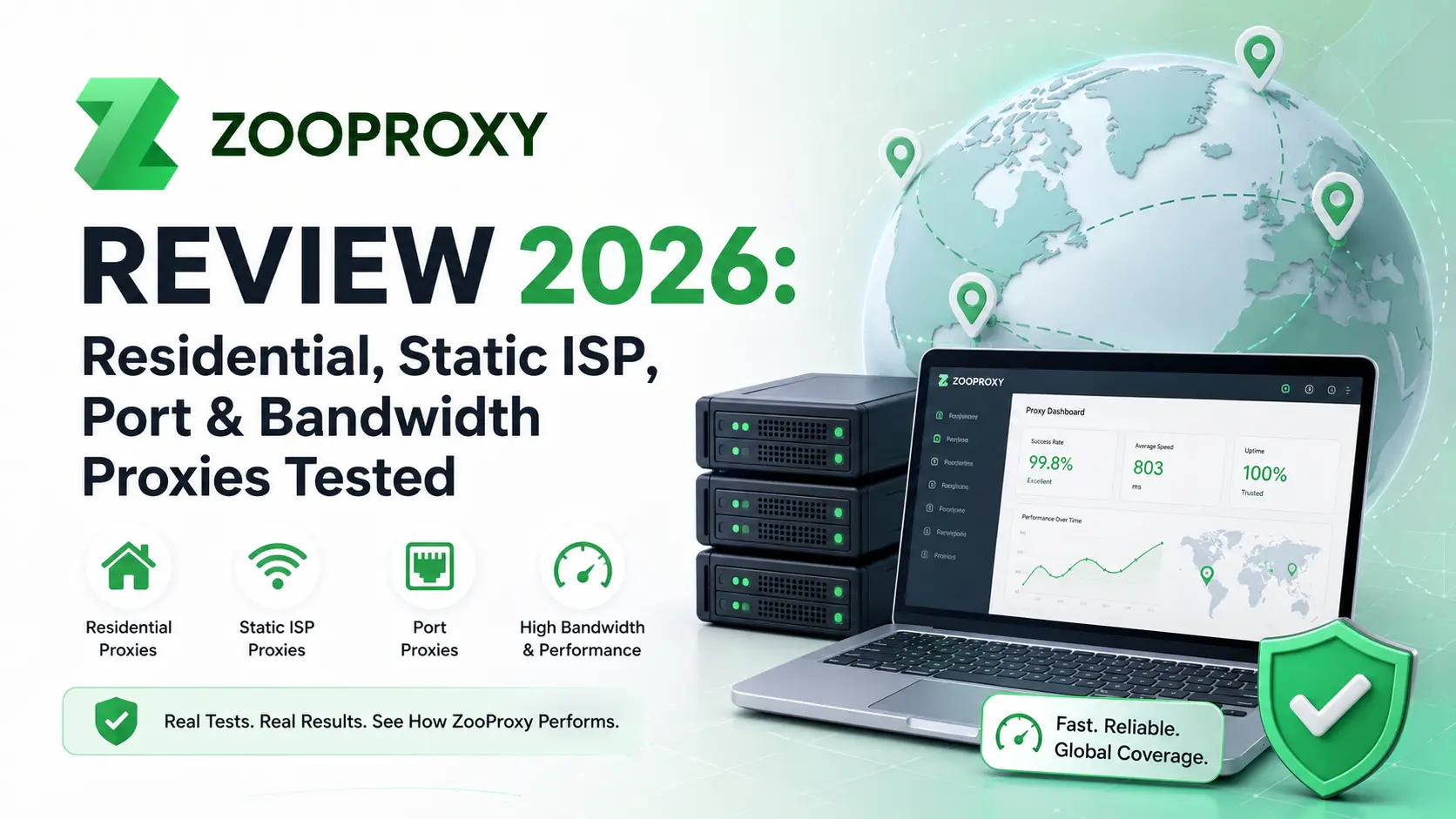
Four pricing pages. Four different billing units. And a checkout that never once asks you which one you actually need. That's the first thing you notice opening ZooProxy for this review — not a single "residential proxy" product with add-ons bolted on, but four separate systems (dynamic residential traffic, long-term static ISP, unlimited-traffic ports, and dedicated bandwidth) sold almost as if they were four different companies sharing one Hong Kong address at 45 Hoi Yuen Road, Kwun Tong. Prices start at $0.40/GB on residential traffic, $2.00/IP on static ISP, $0.38/port/day on the unlimited-port plan, and roughly $23.30/day on dedicated bandwidth, depending on how much volume you commit to upfront. So which one is actually worth your money? That depends entirely on the job. We pulled apart the pricing on all four lines, ran the ASN and risk-score samples ZooProxy publishes on its own static IPs, and weighed the catalog's real flexibility against a support and reputation footprint that's thinner than what most established mobile and residential proxy providers have built up over time.

Here's the split, in plain terms. Dynamic Residential Traffic rotates IPs from a shared pool and bills by the gigabyte, with sticky sessions up to 120 minutes when you need one IP to hold still for a while. Long-term Static ISP does the opposite: you pay once for a fixed IP that's yours alone for 7, 30, or 90 days, unlimited traffic included. Unlimited Traffic - Port charges a flat daily rate per open port and never counts gigabytes, capped around 6 Mbps per port. Unlimited Traffic - Bandwidth skips ports entirely and hands you one dedicated pipe at a bandwidth ceiling you choose. Four pricing tables, four trade-offs, and picking wrong means paying for bandwidth you'll never touch or hitting a GB cap mid-job. Most names on the top proxy provider list don't make you do this math — they sell one thing. ZooProxy makes you the one who decides, which is either an advantage or extra homework depending on how much you already know about your own workload.

Why ZooProxy's Catalog Is Worth a Closer Look
Residential Traffic That Never Expires
Purchased GB stays valid indefinitely and rolls across projects through a shared traffic pool, so a slow month doesn't waste the budget you already paid for.
Native or Broadcast Static ISP
Native IPs (e.g. $4.5/IP for 30 days on US) sit on residential-grade ASNs; cheaper Broadcast IPs cover Thailand, Japan, Malaysia, Singapore, Hong Kong, and Canada from $4.0/IP.
Flat-Rate Ports, No GB Counter
200-500 port bundles drop to $0.45/port/day on the 7-day plan and $0.38/port/day on 30-day billing, each port running an independent residential IP.
Dedicated Bandwidth Channels
500 Mbps dedicated channels run $112.97/day on 30-day billing, aimed at continuous crawling or bulk audio/video transfer rather than casual browsing.
Free City-Level Targeting
City-level geo-targeting doesn't carry a surcharge on the residential or static ISP lines, useful for localized SERP work or regional pricing checks.
Bulk Recharge Discounts
Loading the wallet at $2,000 saves 25% and $5,000 saves 30%, which stacks on top of the already-tiered per-GB and per-port pricing.
ZooProxy's Four Product Lines Explained
Most providers reviewed in the proxy services guide sell one core product and bolt features onto it. ZooProxy runs four separate systems side by side, and picking the wrong one is the easiest way to overpay. Dynamic Residential Traffic is the classic per-GB rotating pool: prices step down from $2.00/GB on the smallest 10GB pack to $0.40/GB once you cross 50TB, with automatic rotation every 1-120 minutes and no expiry date on unused traffic. Long-term Static ISP flips the billing model to per-IP: you pay once for a validity window (7, 30, or 90 days) and that same IP stays yours with unlimited traffic for the whole period, which suits residential-style account work better than rotation does. Unlimited Traffic - Port bills per open port per day regardless of how much data crosses it, each port capped around 6 Mbps but with no GB ceiling, which is the plan built for social media automation running dozens of profiles in parallel. Unlimited Traffic - Bandwidth is the outlier: instead of many small ports it gives one dedicated channel at a chosen bandwidth ceiling (50 to 500 Mbps), better suited to bulk downloads or a single heavy crawler than to account-matrix work.
ZooProxy also publishes real IP samples for the static ISP line, which is more transparency than most providers offer before checkout. A Broadcast-type IP sampled at 64.93.***.205 resolves to Johor Bahru, Malaysia on AS7361 (DataZone Networks LLC) with an 8% risk score. A Native-type IP sampled at 162.141.***.52 resolves to Seoul, South Korea on AS9848 (SEJONG NETWORKS) with a 5% risk score, both scored "Excellent" on ZooProxy's own scale. That gap between Native and Broadcast pricing tiers ($4.5-$7.0/IP for Native versus $4.0-$5.0/IP for Broadcast, both on 30-day billing) tracks with the risk-score gap: Native costs slightly more and scores slightly cleaner. Anyone running an anti-detect browser stack should budget for Native IPs on the accounts that matter most and reserve Broadcast for lower-stakes testing.
ZooProxy Pricing Across All Four Plans (2026)
Every plan uses tiered pricing that rewards volume, and every plan lets you pick the billing window separately from the resource quantity. Dynamic Residential Traffic starts cheap and gets cheaper: a first-order 2GB pack runs $2.40 total, a 400GB "most popular" pack runs $280 ($0.70/GB), and enterprise buyers crossing 50TB land at $0.40/GB. Long-term Static ISP flips the logic: the same US IP costs about $1.00 for 7 days, $4.50 for 30 days, or $11.00 for 90 days, so the per-day cost actually drops the longer you commit. For Unlimited Traffic - Port, 30-day billing beats 7-day billing at every tier: 200-500 ports run $0.45/port/day over 7 days but $0.38/port/day over 30 days. And on Unlimited Traffic - Bandwidth, a 50 Mbps channel is $23.30/day on a 30-day plan versus a $99 one-day starter rate, so the 30-day commitment is the only way to get the advertised entry price.
Dynamic Residential
Long-term Static ISP
Unlimited Port
Unlimited Bandwidth
Recharging the account wallet in bulk stacks a second discount on top of these rates: $100 gets 5% off, $500 gets 15% off, $2,000 gets 25% off, and $5,000 gets the maximum 30% off. That structure rewards teams running steady monthly volume more than it rewards a single small test order, so it's worth modeling your expected 3-month spend before choosing a recharge tier. Buyers comparing ZooProxy against per-GB competitors should check the Bright Data vs Oxylabs vs Smartproxy comparison and the independent rate breakdown at ProxyRates' proxy pricing comparison to see where $0.40-$0.70/GB lands against the wider market.
ZooProxy Performance: Uptime, Speed, and IP Quality
99.92% uptime. Sub-0.5-second average response. Those are the numbers on ZooProxy's own homepage, and we didn't run a controlled multi-week test against them for this review, so take them as a starting claim rather than a verified guarantee — the same caution any proxy security checklist would tell you to apply before a production rollout. What we could check directly is the IP-quality data sitting right on the static ISP order page. A Broadcast IP sampled in Johor Bahru, Malaysia comes back on AS7361 (DataZone Networks LLC) with an 8% risk score. A Native IP sampled in Seoul, South Korea comes back on AS9848 (SEJONG NETWORKS) at 5%. Both get labeled "Excellent" on ZooProxy's own scale — fine, but run them through a second opinion anyway. The proxy checker tool takes thirty seconds and it's the cheapest insurance you'll buy before locking into a 90-day static IP, which is the least flexible thing in this whole catalog if the ASN turns out flagged on your target platform.
| Provider | Model | Entry Price | Billing Unit | Best For | Public Reviews |
|---|---|---|---|---|---|
| ZooProxy ⭐ | Residential + ISP + Port + Bandwidth | $0.40/GB, $0.38/port | GB, IP, port, or day | Multi-model flexibility | Limited public history |
| Bright Data | Residential (per GB) | $8.4+/GB | GB | Global | Extensive |
| Oxylabs | Residential (per GB) | $4+/GB | GB | Enterprise | Extensive |
| Proxy-Seller | ISP + Residential | ~$1.4+/IP | IP or GB | Budget static ISP | Extensive |
| IPRoyal | Mobile + Residential | ~$1.75+/GB | GB | Small teams | Extensive |
Who Should Use ZooProxy's Proxy Network
ZooProxy's own use-case list spans brand protection, e-commerce data collection, social media account management, website and localization testing, AI model training, and multi-store operation, and the four-product split maps reasonably well onto each. Continuous web scraping and AI training pipelines that need weeks of uninterrupted throughput fit the unlimited-bandwidth channels, since there's no GB ceiling to hit mid-run. Multi-account social media and marketplace work fits the unlimited-port plan, where each port keeps an independent identity and a whitelist IP layer restricts who can reach it. Brand-protection and price-monitoring crawls that touch many regions in short bursts fit the pay-per-GB residential pool better than a fixed-IP product would, since the job moves on before any single IP builds enough history to matter. Remote access, gaming acceleration, and long-lived platform logins fit the static ISP line, where the same IP staying fixed for 30 or 90 days is the point rather than a limitation. For a broader framework on matching proxy type to job type, the best mobile proxies for social media management guide and the Telegram expert accounts guide cover adjacent decision points that apply just as well to ISP and residential IPs.
ZooProxy Use Case Matrix
Brand Protection & Anti-Piracy
Rotating residential IPs across many regions suit short, wide sweeps looking for infringement or counterfeit listings.
E-commerce Price & Review Monitoring
Per-GB residential billing keeps cost predictable when the crawl frequency changes week to week.
Social Media Account Matrices
Unlimited ports with whitelist security isolate each profile without a per-GB bill tracking every login.
AI Training Data Collection
Dedicated bandwidth channels support week-long continuous training pulls without a traffic cap interrupting the run.
Remote Access & Multi-Store Ops
Static ISP IPs held for 30 or 90 days keep the same network identity per store or per remote-work login.
Single-Session Low-Latency Gaming
A residential or ISP proxy adds a routing hop; a dedicated low-latency network path fits this need better than any of ZooProxy's four plans.
Support, Payments, and the Affiliate Program
ZooProxy lists 24/7 technical support and a Telegram channel (@ZooproxyTiger) alongside an email address (support@zooproxy.com) as the two direct contact routes. There's no visible public forum, Discord, or Trustpilot profile with a review history at the time of writing, which is the main gap next to providers that have built up years of verified customer feedback; the tgproxy.io residential proxy breakdown and the ProxyAdvice anti-detect browser rankings are both useful cross-references if you want a second opinion on how a newer or lower-profile provider stacks up against the establishment names. On the business side, ZooProxy runs a 12% first-order affiliate commission with withdrawal available at any time, which is a straightforward structure compared to tiered programs elsewhere. A KYC policy is listed alongside the standard Terms of Service, Privacy Policy, and Refund Policy pages, and multiple payment methods are shown at checkout, though the specific card and crypto processors aren't named on the pricing pages themselves, so it's worth confirming your preferred method works before committing to a large recharge tier.
Pros & Cons
ZOOPROXY ANALYSIS
Advantages
Considerations
Final Verdict: ZooProxy Review 2026
So, back to the original question: is ZooProxy worth it? On flexibility, yes. Four billing models under one account, real per-unit pricing that beats plenty of names on the top proxy provider guide, and ASN samples posted right on the checkout page instead of buried in a support ticket. That last part matters more than it sounds — most providers make you buy first and find out the IP quality second. Still, don't skip your own pass through the proxy checker before a 90-day commitment, published sample or not. What ZooProxy doesn't have yet is a track record you can lean on: no long Trustpilot thread, no forum where people complain when something breaks, no zero-cost trial to soften the first order. If you already know how to read an ASN and just want per-GB, per-IP, per-port, and per-bandwidth billing in one place, put in a small test order and see how it holds up. If reputation carries more weight in your decision than raw flexibility does, read this alongside the mobile proxy provider guide, the best proxies for web scraping roundup, or the Bright Data alternatives list before locking in a 90-day plan or a bulk recharge.
Compare ZooProxy's residential, ISP, port, and bandwidth pricing
2GB residential packs from $2.40. Unlimited ports from $0.38/day at volume.
Frequently Asked Questions
Dynamic residential traffic bills by the gigabyte and rotates IPs automatically every 1 to 120 minutes from a shared pool, which suits scraping and short sessions. Static ISP bills per IP for a fixed validity window (7, 30, or 90 days) and keeps that exact IP dedicated to you with unlimited traffic for the whole period, which suits logins, multi-store operation, and any workflow where the same identity needs to persist over time.
There's no zero-cost trial period visible in the pricing pages. The lowest-cost ways to test the network are the first-order 2GB dynamic residential pack at $2.40 total, or the one-day 50 Mbps unlimited-bandwidth starter rate at $99. Neither is free, so budget a small test order rather than expecting a no-cost trial like some competitors run.
Native IPs sit on residential-grade ASNs and cost slightly more (from $4.5/IP on 30-day US pricing), while Broadcast IPs are available in a smaller country list (Thailand, Japan, Malaysia, Singapore, Hong Kong, Canada) at a lower price (from $4.0/IP). Published samples show Native scoring a 5% risk score versus 8% for Broadcast, both labeled Excellent, so the price gap tracks with a real, if modest, quality gap.
Each port is provisioned with its own residential IP and roughly 6 Mbps of throughput, and ports don't share a metered pool the way per-GB traffic does. Running 200-500 ports in parallel at $0.38-$0.45 per port per day means the cost stays flat no matter how much data moves through the ports collectively, which matters most for large multi-account automation setups.
The dynamic residential and static ISP plans list HTTP, HTTPS, and SOCKS5 support, both usable through API calls or standard account-password authentication, and both compatible with mainstream scraping and antidetect-browser tooling.
If community reputation and a long public review history matter most to your decision, ZooProxy is a weaker fit right now than an established name, since no large public Trustpilot or forum presence was visible at the time of writing. If flexible billing across four product types and competitive per-unit pricing matter more, it's worth a small test order before scaling up to a bulk recharge tier.