SingaporeMobileProxy Review 2026: Dedicated SG SIMs Tested
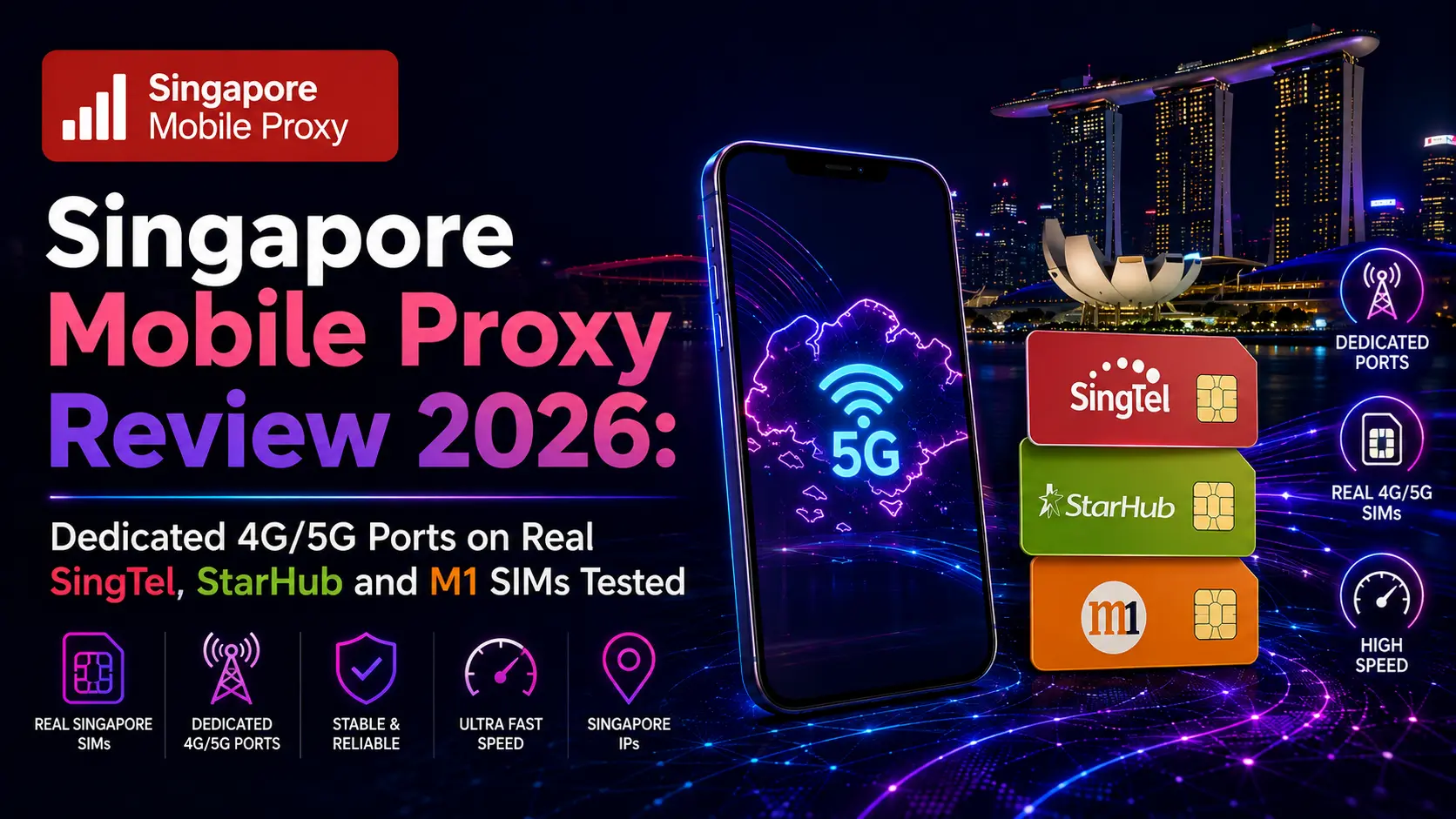
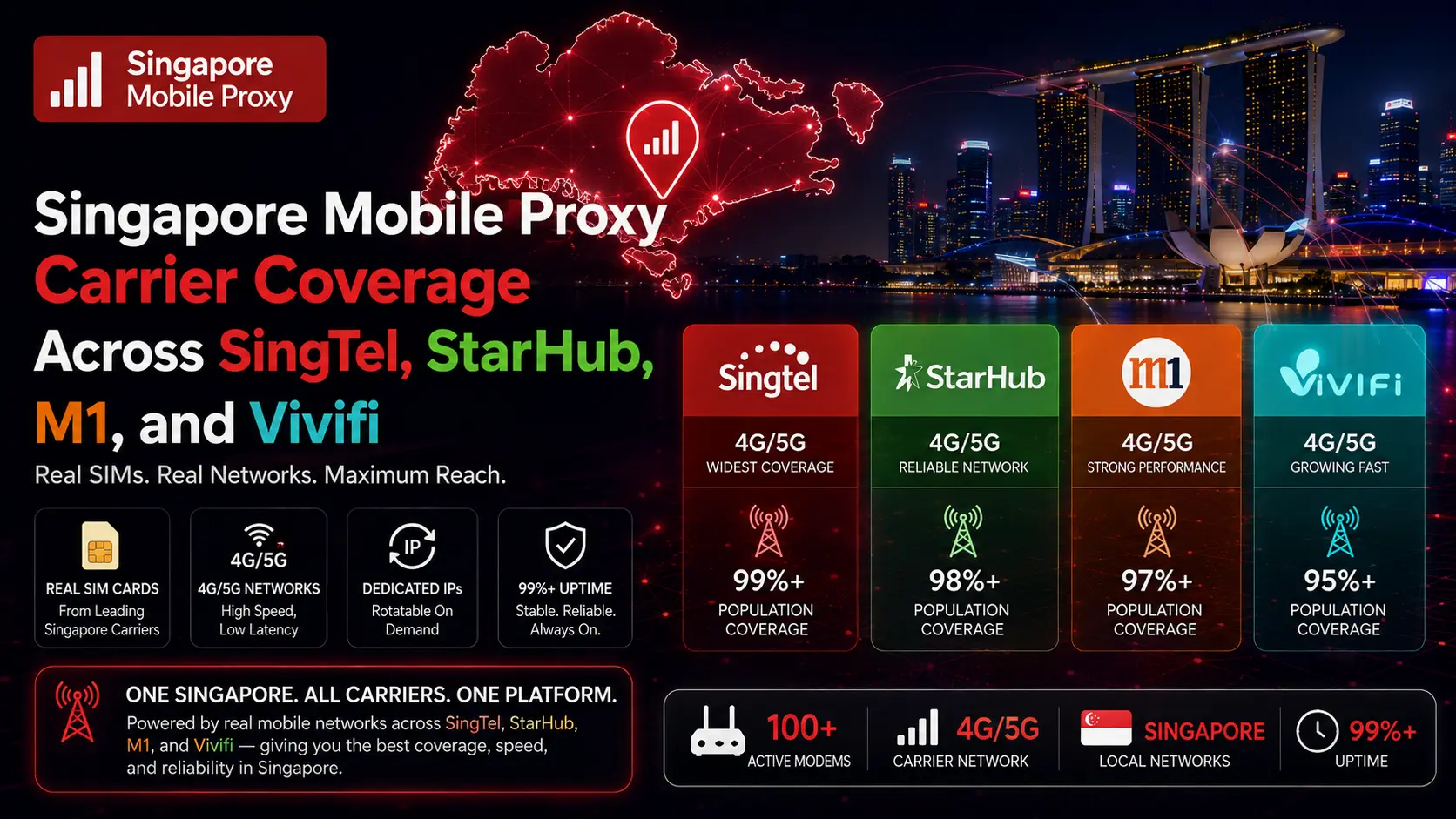
One country. One SIM per port. One customer per SIM. That's the whole pitch Singapore Mobile Proxy (SMP) leads with, and after walking through the plans page, the carrier landing pages, the trial flow, and the MCP integration for Claude and Cursor, it holds up as the actual product: a rack of 100+ physical USB modems in Singapore, each holding a real SingTel, StarHub, M1, or Circles SIM, sold as dedicated ports rather than pooled traffic. There's no residential mesh borrowing bandwidth from unknowing homes, no rebranded datacenter range with a spoofed ASN, no shared pool that carries someone else's ban history into your next request. You buy a port, you get that port's SIM, and the IP resolves to a Singapore mobile carrier's ASN that you can verify on the trial before paying. Whether that narrow, dedicated model beats a broader network like the names on the top proxy provider guide depends entirely on whether your work is Singapore-shaped, which is exactly what this review sets out to answer.

The Coverage score above is deliberate: Singapore Mobile Proxy is only Singapore, and rating it against providers that ship 195 countries would miss the point. What SMP trades geographic breadth for is depth on a single geography, with four consumer carriers (SingTel, StarHub, M1, Circles) covered from physical SIMs the operator owns and runs himself in a Singapore rack. If your target sites care about Singapore-shaped traffic, that split matters more than a global IP count. If you also need US, EU, or CN coverage, you'll pair SMP with a broader network like the ones covered in the definitive residential proxy guide, rather than replace them.
Why Singapore Mobile Proxy Is Worth a Closer Look
Dedicated Port, Never Shared
1 SIM = 1 port = 1 customer. You inherit no one else's ban history because no one else is on your IP. That single design choice is what pooled mobile networks can't match.
Real Carrier SIMs, Verifiable ASN
Physical SingTel, StarHub, M1, and Circles SIMs in modems the operator owns. Check the ASN on the trial port before paying. No spoofed ranges, no relabelled datacenter IPs.
Rotation on Demand, ~20 Seconds
Call the port's rotation link from code or cron. A fresh IP arrives from the same carrier's pool in roughly 20 seconds. Automatic intervals as short as 10 minutes are also supported.
Self-Serve Modem Controls
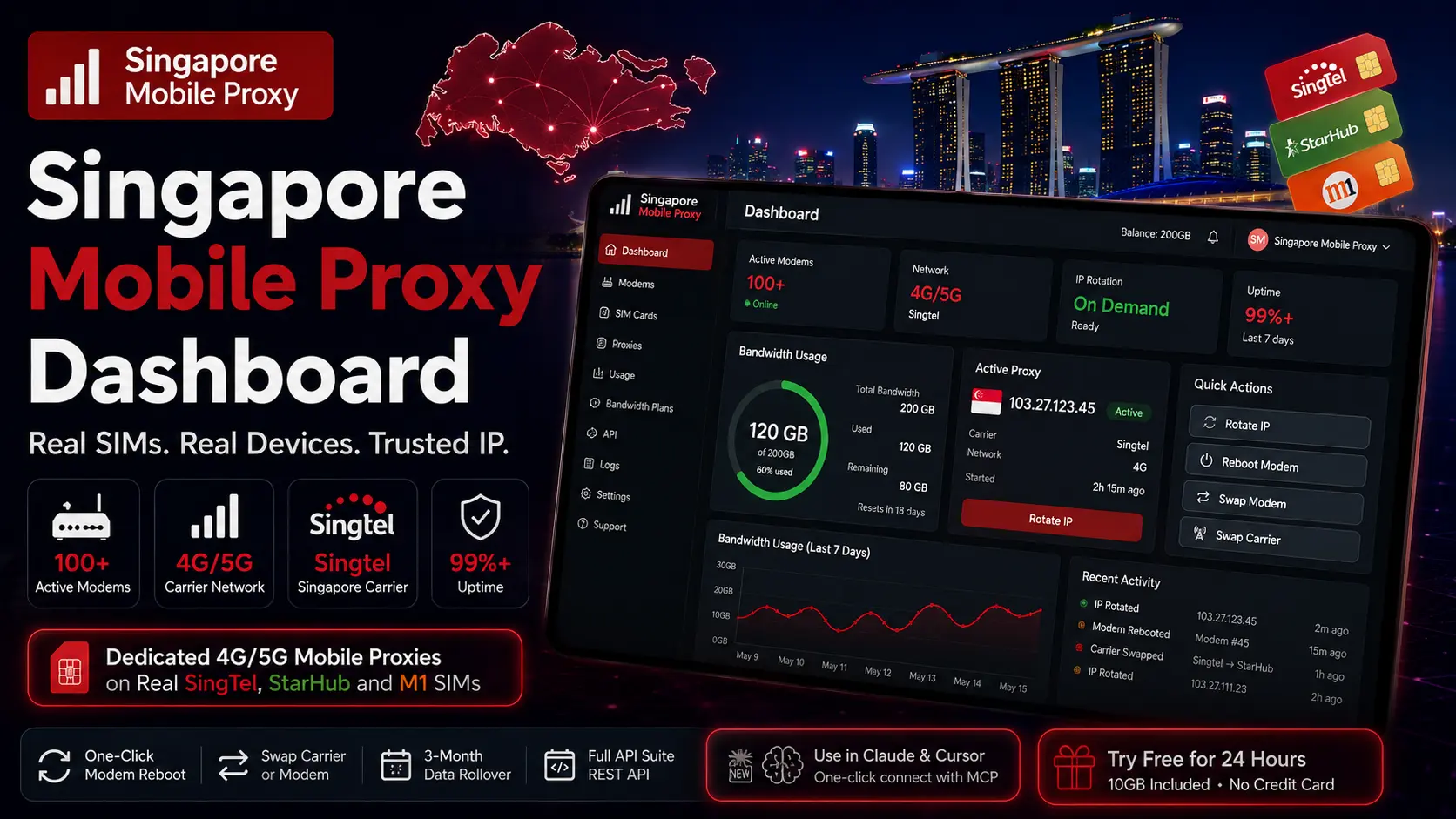
Reboot a stuck modem from the dashboard in one click. Swap yourself to a different carrier or a fresh modem on demand. No ticket queue, no waiting on support to press a button.
MCP Integration for Claude & Cursor
One-click connect adds fetch_url, search_google, and rotate_ip tools to any Model Context Protocol client. Your AI agent sees the web from a real Singapore mobile IP without a line of proxy config.
24-Hour Free Trial, No Card
The trial gives you a real dedicated port with 10GB, not a shared demo. Point your stack at it, run your ASN check, log a test session, and walk away without entering a card if it doesn't fit.
SMP's Product Range: Dedicated Ports Across Four SG Carriers
SMP sells one core product (a dedicated mobile port on a physical Singapore SIM) in a few configurations that change the carrier, the bandwidth, and the port count. Standard ports assign the next healthy modem regardless of carrier, from $40/mo for the entry 200GB tier. Carrier-choice ports let you pin the port to a specific network (SingTel, StarHub, M1, or Circles) from $60/mo, which matters when you're warming or running accounts whose history is already on one carrier. Every port ships HTTP and SOCKS5 on the same credentials, on-demand rotation via a permanent link, and unlimited bandwidth with a 500GB/month fair-use cap on standard plans, or explicit 200GB/500GB/1TB tiers on the newer bandwidth-graded plans. SOCKS5 support is the piece that makes SMP an obvious fit for the workflows covered in the Telegram expert accounts guide, since Telethon, Pyrogram, and GramJS all speak SOCKS5 natively.
Picking between standard and carrier-choice comes down to one question: does the account's history matter yet? For fresh scraping jobs on public SG marketplaces, any healthy modem is fine. For account teams running a multi-account setup across Instagram, TikTok, Shopee, or Lazada, matching the carrier the account was born on removes one signal the platform's fingerprint stack would otherwise flag on. The three-carrier split (some accounts on SingTel, some on StarHub, some on M1) also mirrors how real Singapore users are distributed, which is the pattern that account-management teams working with tools from the BitBrowser anti-detect setup should aim to reproduce. Circles (originally launched as Circles.Life, a well-known SG mobile brand) is available on carrier-choice plans as a fourth option, which gives you a network outside the three-carrier majority for accounts that need that extra diversity.
Singapore Mobile Proxy Pricing: Ports, Bandwidth, and Trials (2026)
Pricing on SMP is published in full on the plans page, which is a rarity in the mobile proxy space where per-port rates often hide behind a "contact sales" wall. Three bandwidth tiers cover the standard configuration: $40/mo for a 200GB port, $50/mo for 500GB, and $85/mo for 1TB. Every tier includes one proxy port, unlimited bandwidth within the cap, automatic IP rotation every 10 minutes, and SOCKS5 alongside HTTP on the same credentials. Multi-port bundles work on the same $40 base for a single dedicated port, moving to $99/mo for three ports and $299/mo for ten, which is cheaper per-port than three separate single-port subscriptions. Carrier-choice ports start at $60/mo. Cross-referencing per-port mobile rates against pooled mobile pricing is the same analysis covered in the ultimate mobile proxy provider guide, and the best mobile proxies for social media guide covers where dedicated-port pricing lands next to the shared-pool models.
200GB Port
500GB Port
1TB Port
Carrier-Choice
Two payment mechanics work in the buyer's favor. Prepay discounts run 17% off for a 12-month commitment, 10% off for six months, and 5% off any crypto payment, which stacks against the annual discount so a 12-month crypto prepay lands close to 22% below month-to-month. GoToProxy readers get an additional 10% off first payment with code GOTOPROXY10 at checkout, which stacks on top of the base tier price. Short-term trial pricing on the 200GB configuration is available as $4 for 24 hours and $13 for 7 days for teams that want more than a 10GB free trial but less than a full month before committing. That trial-to-paid pathway matches the pattern several of the top privacy and performance providers follow, and the exit door is a real one: you keep any unused bandwidth for up to 3 months, so paying for a month you didn't fully use doesn't erase the balance at midnight on day 30.
Singapore Mobile Proxy Performance: Uptime, Speeds, and 4G vs 5G
SMP publishes 99%+ uptime, a self-monitored fleet with automated PPP recovery and USB reset for stuck modems, and speed figures broken down by network generation. We didn't run a controlled multi-week benchmark against those claims for this review, so treat them as starting numbers rather than verified results, the same caution the proxy security and best-practices guide applies to any published SLA. The published speed split is honest about what network generation actually changes: on the 4G/LTE hardware that ships with standard plans, expect 30–60 Mbps down and 10–20 Mbps up, which covers every common workload from account management to typical scraping. On the 5G ports (available on request), the numbers climb to 300+ Mbps down and 40+ Mbps up, which only matters if your job is uploading video, running heavy concurrent sessions, or streaming large media. For sanity-checking a live port's ASN and quality before scaling, the free proxy checker covers the same ground as SMP's built-in fingerprint check tool, and running both is a two-minute due diligence step.
| Provider | Model | SG Coverage | Dedication | Best For | Entry Price |
|---|---|---|---|---|---|
| Singapore Mobile Proxy ⭐ | Dedicated SG port on real SIM | 4 SG carriers, own rack | 1 SIM = 1 customer | SG-only account & scrape work | $40/mo (200GB) |
| Bright Data (Mobile) | Pooled mobile carrier IPs | SG included in 195 | Shared pool | Global enterprise scale | Higher, GB-metered |
| Oxylabs (Mobile) | Pooled mobile carrier IPs | SG included in 195 | Shared pool | Enterprise APIs | Higher, GB-metered |
| IPRoyal (Mobile) | Rotating mobile pool | SG in pool, no dedication | Shared pool | Small-team PAYG | Low, GB-metered |
| Free MTProto Lists | Public Telegram bypass | Any country, random | Thousands share exit | Casual app unblocking | $0 |
Who Should Use Singapore Mobile Proxy
SMP's own landing pages name four use cases (social account management, Telegram operations, SG web scraping, and ad/SERP verification), and the dedicated-port model fits each of them for a different reason. Multi-account social work on Instagram, TikTok, Shopee, and Lazada benefits from the 1-SIM-per-customer rule because platforms score IP reputation on the account level, and shared mobile pools carry every previous user's session hygiene into your next login attempt. That workflow pattern is explored in the proxy use cases for social media automation guide, and pairs naturally with a browser profile stack tested in the anti-detect browser guide. Telegram account teams get SOCKS5 out of the box and a dedicated carrier IP that Telegram's abuse scoring reads as a normal SG phone user, not a datacenter range, which is exactly what free MTProto lists on the public internet can't offer no matter how many mirror servers they publish. Scrapers running SG-localized targets (Shopee, Lazada, Google SG SERPs, local news pricing) get real carrier routing that anti-bot systems pay a real cost to block, since they can't wholesale-ban the CGNAT block a legitimate SingTel subscriber sits behind. Ad verification and SERP tracking benefit from the same real-user routing, which the best proxies for web scraping guide covers in more depth.
SMP Use Case Matrix
TikTok / Shopee / Lazada Accounts
One port per account, one account per port. Carrier-choice pins each account to its history's network, no shared-pool contagion.
Telegram Account Management
SOCKS5 drops straight into Telegram Desktop, iOS, Android, and every Telethon/Pyrogram session. Carrier IP reads as normal phone traffic.
SG-Localized Web Scraping
SG prices, listings, and rankings pulled from real SG carrier IPs. HTTP + SOCKS5 works with Scrapy, Playwright, and Puppeteer out of the box.
SG Ad & SERP Verification
See exactly what a real SG mobile user sees. Verify ad placements and localized SERPs without the datacenter fingerprint that skews results.
AI Agents in Claude / Cursor
MCP tools (fetch_url, search_google, rotate_ip) let a Claude or Cursor session browse from a real SG mobile IP without any proxy config in code.
Non-SG Geographic Work
SMP is Singapore-only by design. For US, EU, or CN targets, pair with a broader provider from the Bright Data alternatives roundup.
Support, Dashboard, and Automation
Support runs through Telegram (@xavierfok), WhatsApp, and email (xavier@singaporemobileproxy.com), with published response times of "usually within a few hours" and no formal ticket portal. That's a small-operator footprint by design: SMP is a specialist shop rather than an enterprise vendor, and the trade-off is direct access to the person actually running the modem rack against the lack of tiered SLAs or 24/7 phone lines. The dashboard fills a lot of the gap that support portals normally cover: one-click modem reboot for a stuck port, self-serve carrier or modem swap, live bandwidth usage tracking, and a full REST API for automated rotation, reboot, swap, and usage queries from your own scripts. The MCP client integration is the piece worth calling out separately: one-click connect adds fetch_url, search_google, and rotate_ip tools to Claude, Cursor, Cline, or any other Model Context Protocol client, which turns a Singapore mobile IP into infrastructure your AI agent can use natively without a line of proxy configuration on your side. Alongside billing, both card and cryptocurrency payments run through the standard checkout, and the crypto path stacks with the 12-month prepay discount for the deepest published rate reduction.
Pros & Cons
SINGAPORE MOBILE PROXY ANALYSIS
Advantages
Considerations
Final Verdict: Singapore Mobile Proxy Review 2026
So, is Singapore Mobile Proxy worth signing up for? If your work is Singapore-shaped (SG account management, SG-localized scraping, SG ad or SERP verification, or an AI agent that needs a real SG mobile view of the web) the answer is yes, and it isn't close. The dedicated 1-SIM-per-customer model, real ASN verification, all four SG carriers covered, HTTP + SOCKS5 out of the box, the MCP integration for Claude and Cursor, and the 24-hour free trial with no card cover the practical due-diligence checklist without any of the usual friction. Prepay discounts stacking to roughly 22% off month-to-month and 3-month bandwidth rollover close the pricing gap against pooled mobile providers for teams whose usage is spiky. Where SMP isn't the answer is anywhere outside Singapore: if you need US, EU, or CN carrier IPs, buy from the broader networks in the top proxy provider guide or the Bright Data vs Oxylabs vs Smartproxy breakdown, and use SMP for the SG leg of a multi-region operation. The cleanest way to test either scenario is the 10GB free trial, followed by a spot-check through the proxy checker and a small paid month before scaling to a multi-port bundle.
Try Singapore Mobile Proxy free for 24 hours
10GB trial, dedicated port on a real SIM, no credit card. Apply code GOTOPROXY10 at checkout when you upgrade.
Frequently Asked Questions