SparkProxy Review 2026: Residential & Static ISP Proxies Tested (20% Off)
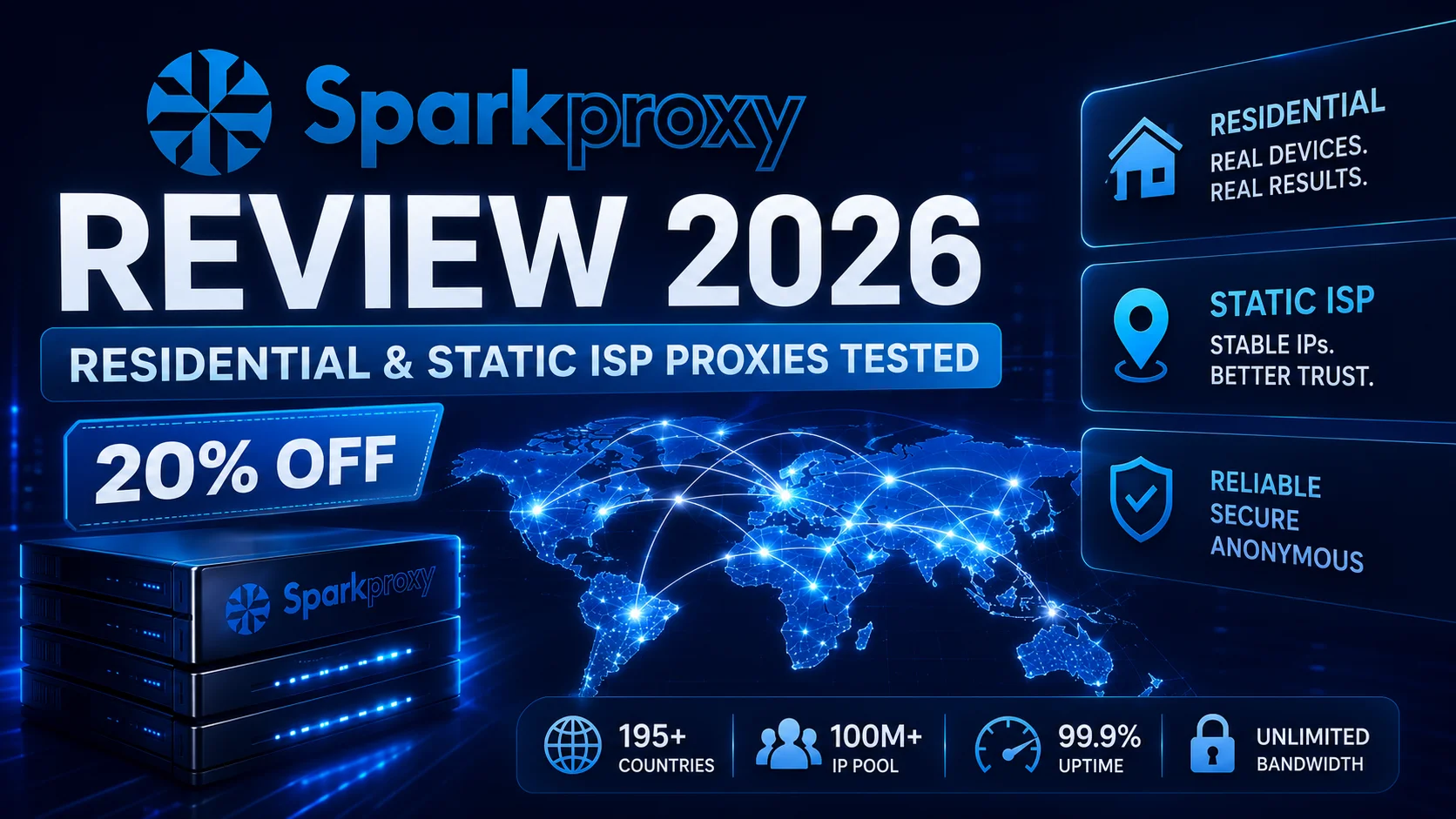
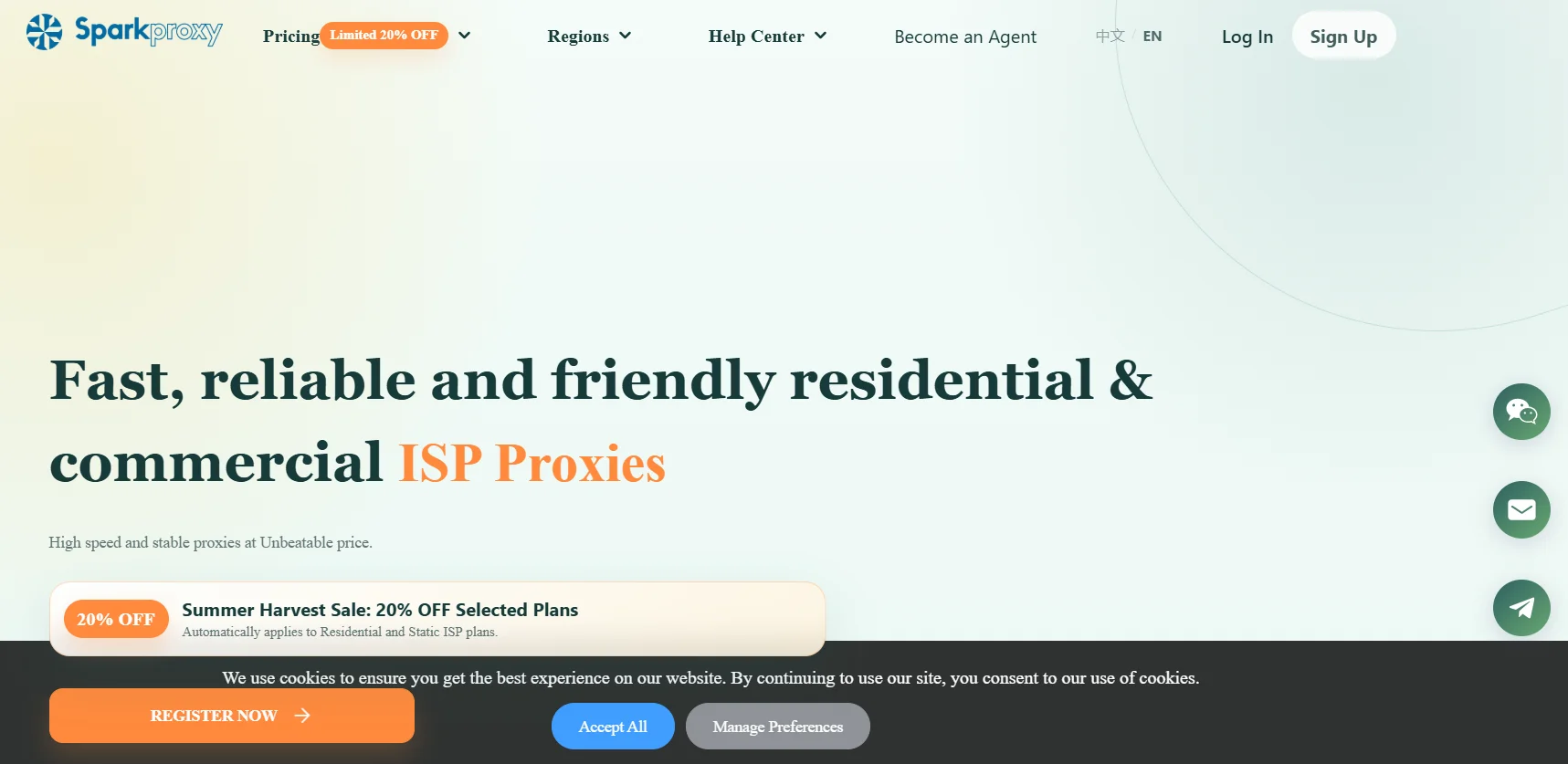
A 20% "Summer Harvest" sale is currently active across SparkProxy's residential and static ISP plans, dropping the 2GB first-order pack to $3.60 and knocking $136.25 off the 500GB Enterprise tier. Promos come and go. What sticks around after the discount clock resets is the underlying catalog: two proxy product lines (rotating residential traffic sold by the gigabyte, and static residential IPs sold per address with billing windows from one week up to a quarter), plus a custom-package track for teams that need something outside the standard menu. The residential pool advertises 90M+ IPs across 190+ locations, the static ISP inventory sits at roughly 100K addresses, and the regions page lists 403,732 US IPs updated daily as the largest single-country pool. Whether those headline numbers hold up against real workloads (and whether the 20% off pricing is actually competitive once you compare it against the rest of the field on the proxy services guide) is what this review is about.

Here's the split in plain terms. Residential Proxies rotate IPs from a 90M+ shared pool and bill by the gigabyte, with sticky sessions up to 30 minutes and free country-plus-city geo-targeting on every tier. Static ISP Proxies flip the model: you pay per IP for a chosen validity window (7 days, 14 days, 30 days, 60 days, or 90 days), the same address stays yours with unlimited traffic, and each IP is picked from a per-country inventory shown right on the pricing page. Custom Service covers anything outside those two menus: higher-bandwidth packages, sticky sessions past the standard cap, or bulk-tier deals arranged through direct contact. Two clean products versus the four-way split some providers ship, which reads either as simpler-to-shop or narrower-catalog depending on what you're buying. Most residential names on the top proxy provider guide land somewhere between those two extremes.
What Makes SparkProxy Worth a Look
360-Day Traffic Validity
Every residential pack keeps its purchased gigabytes usable for a full year from the order date, so a quiet month doesn't wipe out unused traffic the way 30-day expiry plans do.
Granular Per-Country ISP Pricing
The static ISP page prices IPs by city and ASN category (Native, HKCABLE, NTT, and more), from $1.4/IP monthly in Kansas or Hong Kong up to $2.8/IP in Chihuahua, Mexico.
Free City-Level Targeting
City selection carries no upcharge on residential and applies to static ISP as well, useful for regional SERP work, localization tests, and pricing checks.
Wide Antidetect Ecosystem
Sixteen partner brands sit on the front page (Hubstudio, MuLogin, VMLogin, Superbrowser, 拉力猫, mostlogin, and more), so integration guides for popular antidetect browsers tend to already exist.
ISP Renewal Before Expiry
Static IPs can be renewed on the same account before their term ends, keeping the same address for long-lived logins across multi-store setups or remote work.
Bulk Proxy List Export
Purchased ISP IPs can be exported as a list from the dashboard, which speeds up loading dozens of profiles into a proxy manager without copying entries one at a time.
SparkProxy's Two Product Lines (Plus Custom)
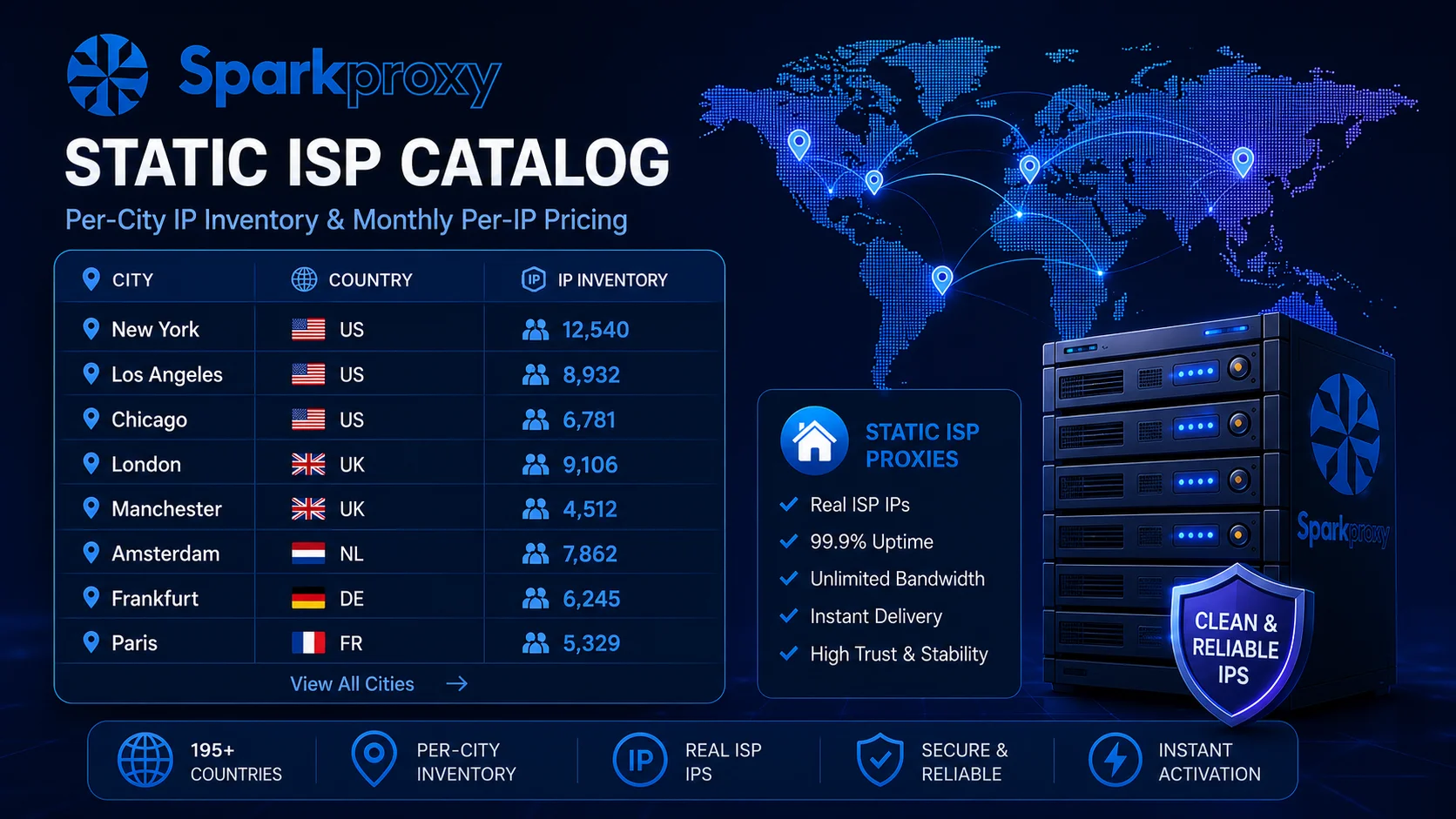
Compared with providers reviewed in the residential proxy providers guide, SparkProxy's shelf is narrower and easier to navigate. Residential Proxies handle the rotating side of the catalog: the shared pool advertises 90M+ IPs across 190+ locations, HTTP, HTTPS, and SOCKS5 are all supported, and every tier from 5GB up to 500GB shares the same 360-day validity window. Sticky sessions are capped at 30 minutes, which suits scraping and short logins better than long-form account work. Effective rates run from $2.50/GB at the 5GB Starter down to $1.36/GB at the 500GB Enterprise, after the 20% off Summer Harvest is applied. Static ISP Proxies take the opposite approach: each IP is assigned to your account exclusively for the paid validity window (7, 14, 30, 60, or 90 days) with unlimited traffic included, and the pricing page lists live inventory counts per city so you know how many IPs are actually available in New York (1,609), Tokyo Native (574), Hong Kong (959), or London Native (507) before ordering. Custom Service covers anything outside the two menus: higher-bandwidth packages, non-standard sticky sessions, or bulk enterprise pricing negotiated by contacting support@sparkproxy.com.
One useful nuance in the ISP catalog is the ASN-tier labeling. Entries tagged Native (US New York, UK London Native, Japan Tokyo Native, Korea Native, Malaysia Johor Native) sit on residential-grade ASNs and price a bit higher than the untagged datacenter-adjacent IPs at the same location. A Japan Tokyo Native IP runs $1.4/IP monthly, an NTT-carrier Tokyo IP runs $2.1/IP, and a London Native IP runs $2.1/IP monthly against $1.4/IP for the untagged London option. That gap gives you a real dial to turn: pay more for cleaner residential-signal ASNs on the accounts that matter (long-lived e-commerce logins, Telegram accounts, or any workflow using an antidetect browser like BitBrowser), reserve the cheaper tier for testing or lower-stakes crawls. Before locking in a 60- or 90-day plan on any city, run the exact IP through the proxy checker tool; SparkProxy doesn't publish ASN or risk-score samples on the checkout page the way some competitors do, so a 30-second independent check is worth it.
SparkProxy Pricing (2026, With 20% Summer Harvest Discount)
Both product lines use tiered pricing, and both currently show the 20% off discount applied automatically on the checkout page. On the Residential side, a first-order-only 2GB pack costs $3.60 ($1.80/GB effective), the 20GB "Most Popular" tier runs $43.75 ($2.19/GB), the 100GB Growth pack lands at $162.50 ($1.63/GB), and the 500GB Enterprise tier drops to $681.25 (about $1.36/GB). Every tier includes country selection at no extra cost and keeps the traffic valid for 360 days from purchase. On the Static ISP side, price is set per IP with the billing window as a separate control: a Kansas or San Jose US IP costs $1.4/IP on a monthly window, a New York IP costs $1.6/IP, a Los Angeles IP $1.8/IP, and a Mexico IP in Chihuahua runs $2.8/IP. Weekly, biweekly, monthly, bimonthly, and quarterly windows are all available; the pricing page defaults to the monthly view, and longer windows lower the effective per-day cost.
Residential Proxies
Static ISP Proxies
Custom Service
Two details worth knowing before ordering. The $3.60 first-purchase 2GB pack works out to $1.80/GB, which is cheaper per-GB than the 5GB Starter at $2.50/GB, so if the goal is a genuine test order the 2GB pack is the better sample size. And on the ISP side, the same US New York inventory has 1,609 IPs listed, versus 79 in Seattle and just 4 in Utah, so exotic-city plans can sell out where high-traffic cities won't. Buyers cross-shopping against per-GB competitors should read the Bright Data vs Oxylabs vs Smartproxy comparison and the independent rate breakdown at ProxyRates' pricing comparison to see how $1.36-$2.50/GB residential and $1.4/IP ISP stack up against the rest of the market.
Performance: Uptime, Latency, and IP Pool Reality
99.9% high-availability uptime. 0.5s lowest latency. 10G+ high-speed bandwidth. Those are the numbers on SparkProxy's own homepage, and we didn't run a controlled multi-week benchmark against them for this review, so treat them as vendor claims rather than measured guarantees, applying the same skepticism any proxy security checklist would recommend. What we could verify directly is the IP-pool size published on the Regions page. The US catalog shows 403,732 IPs updated daily. Great Britain sits at 81,989 IPs. France covers 90,072. Canada holds 67,990, Indonesia 60,587, South Korea 63,186, and Hong Kong (China) 33,971. Those numbers describe the residential rotating pool; the ISP inventory is separate and much smaller, sitting at roughly 100K exclusive addresses across the 25+ countries surfaced on the ISP pricing page. The residential-scale claim of 90M+ IPs across 190+ locations isn't inconsistent with those regional numbers (the pool cycles constantly), just larger than what's visible in a single-day snapshot. Before rolling a 90-day static plan into production, still run the specific IP through the proxy checker and check the reputation guides on tgproxy.io's residential proxy breakdown alongside anything else you already trust.
| Provider | Model | Entry Price | Billing Unit | Best For | Public Reviews |
|---|---|---|---|---|---|
| SparkProxy ⭐ | Residential + Static ISP + Custom | $1.36/GB, $1.4/IP | GB, IP, or window | Multi-account social + ISP | Testimonials on-site |
| Bright Data | Residential (per GB) | $8.4+/GB | GB | Global enterprise | Extensive |
| Oxylabs | Residential (per GB) | $4+/GB | GB | Enterprise scraping | Extensive |
| Proxy-Seller | ISP + Residential | ~$1.4+/IP | IP or GB | Budget static ISP | Extensive |
| IPRoyal | Mobile + Residential | ~$1.75+/GB | GB | Small teams | Extensive |
Who Should Actually Use SparkProxy
SparkProxy's own use-case shortlist covers e-commerce, SEO monitoring, brand protection, social media management, and market research, and the two-product catalog maps onto each of those reasonably cleanly. Multi-account social media automation pairs well with the static ISP line, especially the Native-tagged IPs, because each profile keeps the same address for the full billing window and login continuity matters more than IP variety. Price monitoring, review scraping, and short-burst competitor crawls suit the per-GB residential pool better, since the crawler moves quickly and the 30-minute sticky session cap isn't a blocker. Brand-protection sweeps across many regions fit the residential product too because free city selection lets you check listings in specific US metros or European capitals without paying extra. Long-lived remote access, multi-store management, and workflows that use a fingerprint browser like the ones covered in the mobile proxies for social media management guide or the ProxyAdvice antidetect browser rankings pair naturally with the ISP renew-before-expiry option, since keeping the same IP over months is the whole point.
SparkProxy Use Case Matrix
Social Media Account Matrices
Native-tagged ISP IPs renewed monthly keep each profile on a stable residential-signal address across TikTok, Instagram, and multi-account e-commerce.
E-commerce Price & Review Checks
Per-GB residential with free city selection lets pricing crawlers check listings in specific metros without paying a geo-targeting surcharge.
SERP & SEO Monitoring
Rotating residential with 190+ locations suits daily rank checks across Google's regional indexes, especially when paired with tools from the web scraping tools guide.
Brand Protection & Anti-Piracy
Wide, short sweeps looking for counterfeit listings run cheaply on the residential pool, since 20GB at $43.75 covers a lot of marketplace pages.
Remote Access & Multi-Store
Static ISP IPs held for 30, 60, or 90 days keep the same network identity per store or per remote-work login, with renewal available before expiry.
Low-Latency Gaming Routes
Residential proxies add hops that hurt ping; the proxy vs VPN for gaming guide covers what actually helps latency.
Support, Payments, and Partner Ecosystem
SparkProxy publishes a support email (support@sparkproxy.com) as the primary contact, advertises 24/7 support on the homepage, and runs a bilingual (Chinese and English) knowledge base with FAQs covering payment, protocol support, DNS troubleshooting, and IP region recognition. FAQ answers confirm that HTTP, HTTPS, and SOCKS5 are all supported and that proxies work on mobile devices. Where SparkProxy stands out from newer arrivals in the mobile proxy providers roundup is the partner ecosystem on the front page: sixteen brand integrations are listed, spanning fingerprint browsers (Hubstudio, MuLogin, VMLogin, 花漾, 拉力猫, mostlogin, 火云, Superbrowser, 途纹 TUBROWSER), social-automation platforms (LumiTok, TakeFlow, FastTK), cloud phones (DuoPlus), and virtual-card / cross-border payment services (HuiTongCard, PayTrades). That's a wider integration surface than most standalone proxy shops maintain, and it hints at where SparkProxy's customer base actually sits: cross-border e-commerce and multi-account social operators, not pure enterprise scraping. There's no visible Trustpilot profile with a long third-party review history at the time of writing; testimonials on the site are on-page rather than externally verified, so for a second opinion cross-check with the proxy services top providers guide before scaling up.
Pros & Cons
SPARKPROXY ANALYSIS
Advantages
Considerations
Final Verdict: SparkProxy Review 2026
So, is SparkProxy worth ordering? For its two named jobs, yes. Multi-account social media and cross-border e-commerce sit right in the sweet spot: Native-tagged ISP IPs at $1.4-$2.5 per address on billing windows you actually control, plus a residential pool with 360-day traffic validity, free city targeting, and effective rates as low as $1.36/GB at scale. Sixteen partner integrations on the front page suggest a real customer base of fingerprint-browser operators and multi-account sellers, not enterprise scraping tourists. What SparkProxy hasn't built yet is a long third-party reputation footprint. No visible Trustpilot thread with hundreds of reviews, no big forum presence to check when something breaks, no ASN samples on the ISP checkout page. If reputation carries more weight in your decision than active discounts and granular per-country pricing, cross-check this review against the mobile proxy stealth guide, the best proxies for web scraping roundup, and the Bright Data alternatives list before locking in a quarterly ISP plan. If per-unit pricing and the current 20% Summer Harvest discount matter more, the $3.60 first-order 2GB pack is a real entry point; buy that, test on your actual workload, then scale up from what you measure rather than what the homepage advertises.
Residential from $1.36/GB, static ISP IPs from $1.4/month
2GB first-order pack drops to $3.60. 360-day traffic validity on every tier.
Frequently Asked Questions
Residential proxies bill by the gigabyte and rotate IPs from a shared 90M+ pool with sticky sessions up to 30 minutes, suited to scraping and short logins. Static ISP proxies bill per IP for a fixed validity window (7, 14, 30, 60, or 90 days) and keep the same address dedicated to you with unlimited traffic, suited to long-lived e-commerce, social media, and multi-store logins.
There's no zero-cost trial. The lowest-cost way to test the network is the first-order-only 2GB residential pack at $3.60 total after the 20% off Summer Harvest discount, which works out to $1.80/GB and is enough traffic for a real workload sample before committing to a bigger pack.
Every residential pack keeps its purchased gigabytes usable for 360 days from the order date, which is longer than the 30-day expiry many competitors use. That validity applies from the 2GB first-order pack up to the 500GB Enterprise tier, so a paused project doesn't wipe out already-paid traffic.
Native-tagged IPs sit on residential-grade ASNs and price slightly higher (a Native Tokyo IP is $1.4/IP monthly, a Native London IP is $2.1/IP, a Native Johor Malaysia IP is $2.5/IP), while untagged options run closer to datacenter-adjacent IPs at the same city. Native IPs typically carry a cleaner reputation signal and fit better on high-stakes accounts, while untagged IPs work for testing or lower-stakes crawls.
Both the residential and static ISP plans support HTTP, HTTPS, and SOCKS5. The FAQ confirms compatibility with mobile devices as well, so setups running from Android or iOS work the same way as desktop connections.
Yes. The static ISP dashboard lets you renew IPs before their validity window ends, so the same address stays with your account across billing cycles. That matters for multi-store operators and long-lived logins where switching IPs mid-account can trigger platform re-verification.