How to Build Unblockable AI Training Data Pipelines with Residential Proxies | GoToProxy
Introduction: The AI Data Paradox
Artificial intelligence is only as good as the data that feeds it. Yet the very scale at which modern AI systems require data—terabytes of text, millions of images, billions of behavioral signals—makes traditional collection methods obsolete. The web is the world’s richest dataset, but it is increasingly locked behind sophisticated anti-bot defenses that treat large-scale data collection as a threat.
This creates a paradox: AI needs more data than ever, but the infrastructure for gathering that data is breaking down. Datacenter IPs are blacklisted en masse. CAPTCHA challenges block automated pipelines. JavaScript fingerprinting detects headless browsers before they load a single page. For AI teams, this isn’t a technical inconvenience—it’s an existential risk to model quality.
The solution lies in a technology that has evolved from a niche scraping tool into essential AI infrastructure: residential proxies. By routing data collection through genuine consumer internet connections, residential proxies. restore the stealth, geographic diversity, and scale that AI training pipelines demand. When combined with modern anti-bot evasion techniques, they create pipelines that are not merely functional but truly unblockable.
In this guide, we will walk through the architecture of resilient AI data pipelines, from proxy selection and fingerprint management to behavioral mimicry and production scaling. Whether you are training large language models, building computer vision systems, or developing recommendation engines, this is the blueprint for collecting training data at scale without interruption.
Part 1: Understanding the Anti-Bot Landscape That Blocks AI Data Collection
The Five Layers of Modern Bot Detection
To build unblockable pipelines, you must first understand what you are evading. Modern anti-bot systems do not rely on a single check; they employ layered defense architectures that combine multiple signals into a risk score. If any layer detects anomalies, the entire request is flagged, blocked, or served a CAPTCHA.
Layer 1: IP Reputation and Rate Limiting
Every request begins with its IP address. Anti-bot systems maintain massive databases of known datacenter ranges, VPN exit nodes, and previously abusive IPs. A single request from a flagged IP can trigger instant blocking, regardless of how legitimate the subsequent behavior appears. Rate limiting compounds this: even clean IPs face throttling if request volume exceeds human-like patterns.
Layer 2: TLS and HTTP Fingerprinting
Before any page content loads, the TLS handshake reveals critical information about the client. JA3 fingerprinting captures the unique signature of cipher suites, extensions, and protocol versions that each browser or library produces. If your scraper claims to be Chrome but presents a Python requests library TLS signature, the mismatch is immediate and fatal. HTTP header ordering and protocol version (HTTP/1.1 vs. HTTP/2 or HTTP/3) provide additional detection signals.
Layer 3: Browser Fingerprinting
Once the connection is established, JavaScript probes collect dozens of browser attributes: navigator.webdriver, screen resolution, WebGL renderer, canvas hash, installed fonts, audio context, timezone, and language settings. Headless browsers leak these signals by default—empty plugin lists, SwiftShader rendering instead of GPU output, and automation flags that real browsers never expose.
Layer 4: Behavioral Analysis
The most sophisticated layer monitors how users interact with pages. Mouse movements, scroll patterns, click timing, form fill dynamics, and navigation flow all contribute to a behavioral profile. Bots that load pages and instantly extract data, scroll in perfect increments, or navigate without hesitation are easily identified. Machine learning models trained on billions of human interactions can detect statistical anomalies that rule-based systems miss.
Layer 5: Server-Side Risk Scoring
Finally, backend systems aggregate all signals—IP history, fingerprint consistency, behavioral patterns, and previous challenge outcomes—into a dynamic risk score. This score determines whether to serve content, present a CAPTCHA, or block outright. Because these models adapt continuously, evasion techniques that worked last month may fail today.
Why AI Data Collection Is Particularly Vulnerable
AI training pipelines face unique challenges that make them especially susceptible to anti-bot detection:
- Volume: Training a large language model may require billions of documents. At that scale, even low detection rates compound into massive data loss.
- Diversity: AI needs data from diverse sources—different languages, geographies, and domains. This requires navigating varied anti-bot systems with different sensitivity levels.
- Freshness: Unlike static datasets, many AI applications require real-time or near-real-time data. This precludes offline collection and demands continuous, high-frequency scraping.
- Structure: AI training data often requires specific formats (JSON, structured HTML, API responses). Anti-bot systems that serve simplified or manipulated content to suspected bots directly corrupt training datasets.
Datacenter proxies fail against these challenges because they are systematically detectable at Layer 1. Even with perfect fingerprinting and behavior, a datacenter IP carries a permanent reputation deficit. This is why residential proxies have become the non-negotiable foundation of serious AI data infrastructure.
Part 2: Why Residential Proxies Are the Foundation of Unblockable AI Pipelines
The Residential Proxy Advantage
A residential proxy routes your requests through IP addresses assigned by Internet Service Providers (ISPs) to actual home users. When your AI pipeline queries a target website through a residential proxy, the request appears to originate from a genuine consumer browsing from their living room. This provides three critical advantages that no other proxy type can match:
1. IP Reputation That Mirrors Real Users
Residential IPs carry the trust score of legitimate consumer traffic. Major websites cannot blanket-block residential ranges without risking false positives that would alienate real customers. While individual IPs may still face rate limits if abused, the pool as a whole maintains a baseline reputation that datacenter IPs can never achieve.
2. Geographic and Cultural Authenticity
AI models trained on data collected from a single geographic perspective develop dangerous biases. A model trained only on US East Coast datacenter perspectives will misunderstand regional dialects, miss local market dynamics, and fail on culturally specific tasks. Residential proxies enable collection from 195+ countries with city-level precision, ensuring training data reflects genuine global diversity.
3. Dynamic IP Pools That Resist Exhaustion
Quality residential proxy providers maintain millions of rotating IPs. Because these addresses belong to real users who come online and offline naturally, the pool constantly refreshes. Even if some IPs are flagged, the rotating architecture ensures continuous access through fresh addresses.
Residential vs. Datacenter vs. Mobile: Choosing the Right Proxy for AI Workloads
| Proxy Type | Stealth Level | Speed | Cost | Best Use Case for AI |
|---|---|---|---|---|
| Datacenter | Low | Very Fast | Very Low | Internal testing, non-protected sources |
| Residential | High | Moderate | Moderate | Primary AI training data collection |
| Mobile | Very High | Variable | High | Heavily protected targets, final fallback |
For most AI training pipelines, residential proxies strike the optimal balance. They provide sufficient stealth for the vast majority of targets while maintaining manageable costs at scale. Mobile proxies are reserved for only the most aggressively protected platforms where residential IPs face concentrated blocking.
Thordata: A Residential Proxy Infrastructure Built for AI Scale
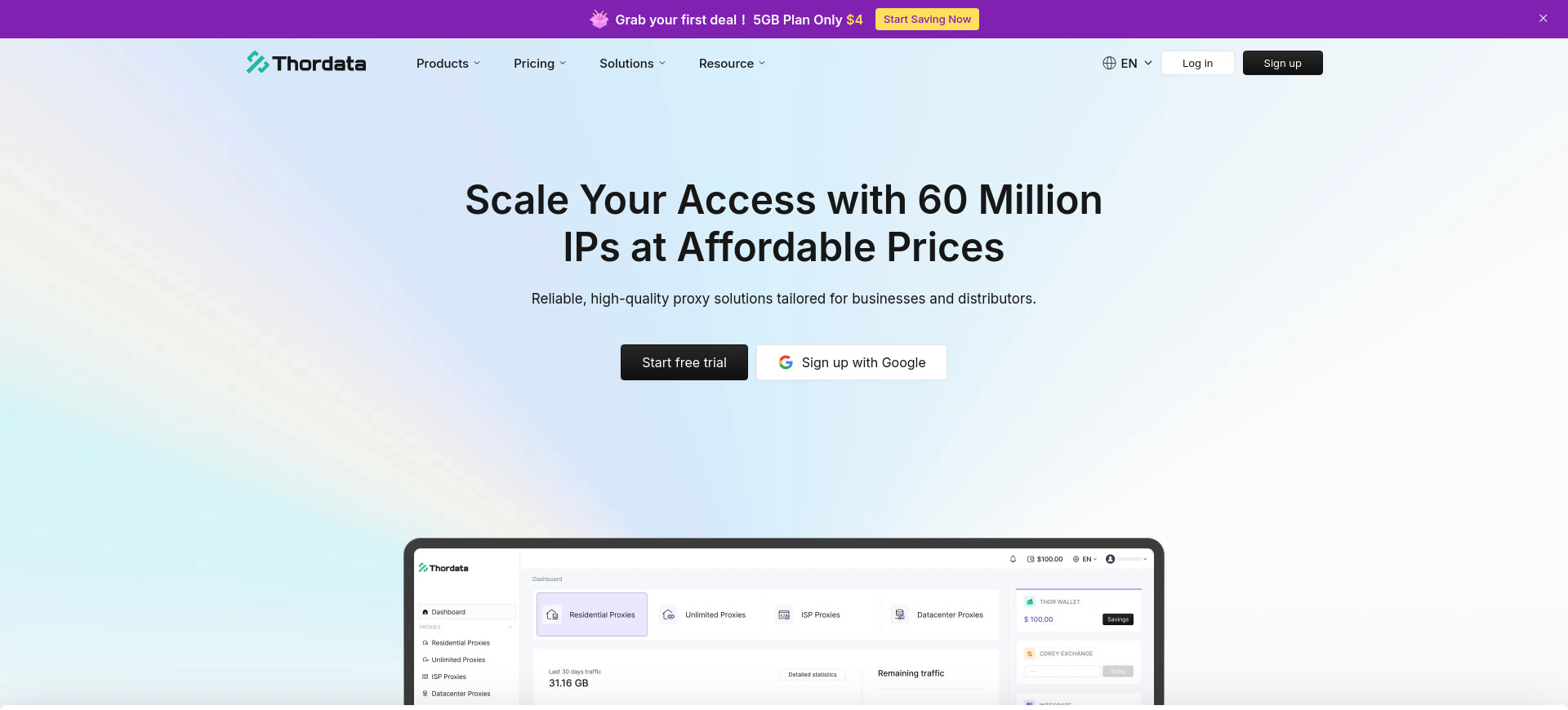
For teams building production AI pipelines, Thordata offers a residential proxy network specifically architected for large-scale data collection. With 60 million+ ethically sourced IPs across 195+ countries, 99.9% uptime, and pricing starting at approximately $0.65 per GB (with enterprise rates scaling to $0.40/GB), Thordata provides the geographic diversity and reliability that AI training demands.
What distinguishes Thordata for AI workflows is its integrated ecosystem beyond raw proxies:
Structured search engine data extraction with built-in anti-bot handling
$0.70 / 1K responses
120+ prebuilt scrapers for major platforms including Amazon, LinkedIn, and Google Maps
$0.50 / 1K results
Automated HTML extraction with proxy rotation and JavaScript rendering
$1.00 / 1K responses
Headless browser environment with Puppeteer/Playwright support and built-in evasion
$2.50 / GB
6 billion original videos from 700 million channels for multimodal model training
Custom pricing
This integrated approach eliminates the engineering overhead of maintaining separate proxy, scraper, and anti-bot infrastructure—allowing AI teams to focus on model development rather than data collection mechanics.
🚀 Start Building Your AI Data Pipeline
Get 60M+ residential IPs across 195+ countries with 99.9% uptime — starting at $0.65/GB
Try Thordata Free →Part 3: Step-by-Step Guide—Building Your Unblockable AI Pipeline
Step 1 Architecture Design and Proxy Selection
Before writing code, design your pipeline architecture around these principles:
Geographic Distribution Strategy
Map your AI’s target markets to proxy locations. For a multilingual LLM, allocate proxy bandwidth proportionally to language prevalence: 25% English (US/UK/AU), 20% Mandarin (China/Taiwan), 15% Spanish (Spain/Mexico/Argentina), 10% Hindi (India), and remaining bandwidth across German, French, Japanese, Arabic, and Portuguese markets.
Rotation vs. Sticky Session Planning
- Rotating sessions: New IP per request. Use for high-volume, stateless collection (product catalogs, news articles, search results).
- Sticky sessions: Same IP for 5-30 minutes. Use for stateful workflows (logged-in accounts, multi-page forms, checkout flows).
Failover Architecture
Implement multi-tier fallback: primary residential → secondary residential (different provider subnet) → mobile proxy (for critical targets only). This ensures pipeline continuity even if one proxy pool faces temporary degradation.
Step 2 Thordata Integration and Configuration
Account Setup
- Register at Thordata and create an account
- Navigate to the Dashboard and select “Residential Proxy”
- Create authentication credentials under “Users” or whitelist your server IPs
- Use the “Endpoint Generator” to create location-specific proxy endpoints
- Choose “Rotating” for per-request IP changes or “Sticky” for session persistence
Python Integration Example
import requests
import json
import time
import random
from datetime import datetime
from urllib.parse import quote

# Thordata residential proxy configuration
# Country-specific endpoints for geographic diversity
THORDATA_ENDPOINTS = {
    'us': 'http://username:password@us.thordata.com:10000',
    'uk': 'http://username:password@uk.thordata.com:10000',
    'de': 'http://username:password@de.thordata.com:10000',
    'jp': 'http://username:password@jp.thordata.com:10000',
    'br': 'http://username:password@br.thordata.com:10000',
    'in': 'http://username:password@in.thordata.com:10000',
    'fr': 'http://username:password@fr.thordata.com:10000',
}

# Realistic browser headers matched to proxy location
def get_headers(location):
    headers_by_locale = {
        'us': {
            'User-Agent': 'Mozilla/5.0 (Windows NT 10.0; Win64; x64) AppleWebKit/537.36',
            'Accept-Language': 'en-US,en;q=0.9',
            'Accept-Encoding': 'gzip, deflate, br',
            'Accept': 'text/html,application/xhtml+xml,application/xml;q=0.9,*/*;q=0.8',
        },
        'jp': {
            'User-Agent': 'Mozilla/5.0 (Macintosh; Intel Mac OS X 10_15_7) AppleWebKit/537.36',
            'Accept-Language': 'ja-JP,ja;q=0.9,en-US;q=0.8',
            'Accept-Encoding': 'gzip, deflate, br',
            'Accept': 'text/html,application/xhtml+xml,application/xml;q=0.9,*/*;q=0.8',
        },
        # Add additional locales as needed
    }
    return headers_by_locale.get(location, headers_by_locale['us'])

def collect_ai_training_data(url, location='us', max_retries=5):
    """
    Collect training data with anti-bot resilience
    """
    proxy = {
        'http': THORDATA_ENDPOINTS[location],
        'https': THORDATA_ENDPOINTS[location]
    }
    headers = get_headers(location)

    for attempt in range(max_retries):
        try:
            # Exponential backoff with jitter
            if attempt > 0:
                sleep_time = (2 ** attempt) + random.uniform(0, 2)
                time.sleep(sleep_time)

            response = requests.get(
                url,
                proxies=proxy,
                headers=headers,
                timeout=30,
                allow_redirects=True
            )

            if response.status_code == 200:
                # Validate content quality before returning
                if len(response.text) > 1000 and 'captcha' not in response.text.lower():
                    return {
                        'content': response.text,
                        'status': 200,
                        'location': location,
                        'timestamp': datetime.now().isoformat(),
                        'content_length': len(response.text)
                    }
                else:
                    # Likely blocked or served simplified content
                    continue

            elif response.status_code == 429:
                # Rate limited - will retry with backoff
                continue

            elif response.status_code in [403, 503]:
                # Blocked - switch location on next attempt
                continue

        except Exception as e:
            if attempt == max_retries - 1:
                raise Exception(f"Failed after {max_retries} attempts: {e}")
            continue

    raise Exception("Max retries exceeded, content validation failed")
Step 3 Implementing Multi-Layer Anti-Bot Evasion
Fingerprint Consistency Management
Your proxy location, headers, timezone, and browser fingerprint must tell the same story. A German IP paired with US English headers and a Pacific timezone is an immediate red flag.
def validate_fingerprint_consistency(proxy_location, headers, timezone):
    """
    Ensure all identity signals align
    """
    locale_map = {
        'us': {'lang': 'en-US', 'tz': 'America/New_York'},
        'de': {'lang': 'de-DE', 'tz': 'Europe/Berlin'},
        'jp': {'lang': 'ja-JP', 'tz': 'Asia/Tokyo'},
    }

    expected = locale_map.get(proxy_location)
    if not expected:
        return True  # Unknown location, skip validation

    lang_match = expected['lang'] in headers.get('Accept-Language', '')
    tz_match = timezone == expected['tz']

    return lang_match and tz_match
Human-Like Behavior Simulation
For JavaScript-heavy targets or those with behavioral analysis, implement realistic interaction patterns:
def human_like_delay(action_type='navigation'):
    """
    Variable delays based on action type
    """
    delay_ranges = {
        'navigation': (2.0, 5.0),      # Between page loads
        'scroll': (0.4, 1.6),           # Between scroll actions
        'click': (0.5, 2.0),            # Before clicking
        'read': (3.0, 8.0),             # Simulated reading time
        'typing': (0.03, 0.18),         # Between keystrokes
    }
    min_delay, max_delay = delay_ranges.get(action_type, (1.0, 3.0))
    return random.uniform(min_delay, max_delay)

def simulate_human_scroll(driver, total_height, steps=6):
    """
    Piecewise scrolling with variable speed
    """
    for i in range(1, steps + 1):
        target_y = int((total_height / steps) * i)
        driver.execute_script(f"window.scrollTo(0, {target_y});")
        time.sleep(human_like_delay('scroll'))
Step 4 Production Pipeline Orchestration
Distributed Collection Architecture
from concurrent.futures import ThreadPoolExecutor, as_completed
import queue

class AI_DataPipeline:
    def __init__(self, target_urls, locations, max_workers=10):
        self.url_queue = queue.Queue()
        for url in target_urls:
            self.url_queue.put(url)
        self.locations = locations
        self.max_workers = max_workers
        self.results = []
        self.failed_urls = []

    def worker(self, location):
        while not self.url_queue.empty():
            try:
                url = self.url_queue.get(timeout=1)
                result = collect_ai_training_data(url, location)
                self.results.append(result)
            except Exception as e:
                self.failed_urls.append({'url': url, 'error': str(e)})
            finally:
                self.url_queue.task_done()

    def run(self):
        with ThreadPoolExecutor(max_workers=self.max_workers) as executor:
            # Distribute workers across locations
            futures = []
            for i in range(self.max_workers):
                location = self.locations[i % len(self.locations)]
                futures.append(executor.submit(self.worker, location))

            for future in as_completed(futures):
                future.result()

        return {
            'successful': len(self.results),
            'failed': len(self.failed_urls),
            'data': self.results
        }

# Usage
pipeline = AI_DataPipeline(
    target_urls=training_urls,
    locations=['us', 'uk', 'de', 'jp', 'br'],
    max_workers=20
)
dataset = pipeline.run()
Quality Assurance and Validation
Implement automated checks to ensure collected data meets training standards:
def validate_training_data(data_point):
    """
    Validate data quality for AI training
    """
    checks = {
        'min_length': len(data_point['content']) > 500,
        'no_captcha': 'captcha' not in data_point['content'].lower(),
        'no_error_pages': all(err not in data_point['content'] for err in
                             ['404 Not Found', '403 Forbidden', 'Access Denied']),
        'language_match': detect_language(data_point['content']) == data_point['location'],
        'timestamp_fresh': (datetime.now() - datetime.fromisoformat(data_point['timestamp'])).days < 7
    }

    return all(checks.values()), checks
Step 5 Using Thordata APIs for Zero-Scraper Pipelines
For teams that want to bypass scraper maintenance entirely, Thordata’s APIs handle the entire anti-bot pipeline:
# SERP API for search-aware training data
def collect_search_data(query, location="United States", pages=5):
    api_url = "https://api.thordata.com/serp"
    all_results = []

    for page in range(pages):
        params = {
            'q': query,
            'location': location,
            'page': page,
            'api_key': 'YOUR_API_KEY'
        }

        response = requests.get(api_url, params=params, timeout=60)
        if response.status_code == 200:
            data = response.json()
            all_results.extend(data.get('organic_results', []))
            # Respectful pacing even with API
            time.sleep(random.uniform(0.5, 1.5))

    return all_results

# Web Scraper API for structured platform data
def collect_structured_data(target_url, scraper_type='generic'):
    api_url = "https://api.thordata.com/scraper"

    payload = {
        'url': target_url,
        'scraper': scraper_type,
        'api_key': 'YOUR_API_KEY'
    }

    response = requests.post(api_url, json=payload, timeout=60)
    return response.json()
Part 4: Advanced Strategies for Unblockable AI Pipelines
Strategy 1: Adaptive Fingerprint Rotation
Static fingerprints, even if initially successful, will eventually be profiled and blocked. Implement dynamic rotation:
import hashlib

class FingerprintManager:
    def __init__(self):
        self.fingerprints = self._load_fingerprint_pool()
        self.current_index = 0

    def _load_fingerprint_pool(self):
        # Load diverse browser profiles: Chrome, Firefox, Safari, Edge
        # across Windows, macOS, Linux, iOS, Android
        return [...]  # Pre-built profile database

    def get_next_fingerprint(self, proxy_location):
        fingerprint = self.fingerprints[self.current_index]
        self.current_index = (self.current_index + 1) % len(self.fingerprints)

        # Ensure geographic alignment
        fingerprint['timezone'] = self._location_to_timezone(proxy_location)
        fingerprint['locale'] = self._location_to_locale(proxy_location)

        return fingerprint

    def _location_to_timezone(self, location):
        mapping = {
            'us': 'America/New_York',
            'uk': 'Europe/London',
            'de': 'Europe/Berlin',
            'jp': 'Asia/Tokyo',
        }
        return mapping.get(location, 'UTC')
Strategy 2: Session Warm-Up and Cookie Aging
New sessions are more heavily scrutinized than returning visitors. Implement warm-up protocols:
def warm_up_session(proxy, headers, duration=90):
    """
    Simulate natural browsing before target data collection
    """
    warm_up_urls = [
        'https://www.google.com',
        'https://www.youtube.com',
        'https://www.reddit.com'
    ]

    session = requests.Session()
    session.proxies = proxy
    session.headers.update(headers)

    start_time = time.time()
    while time.time() - start_time < duration:
        url = random.choice(warm_up_urls)
        session.get(url, timeout=30)
        time.sleep(random.uniform(5, 15))

    return session  # Return aged session with cookies
Strategy 3: Telemetry-Driven Adaptive Throttling
Monitor your pipeline’s success metrics and adjust behavior dynamically:
class AdaptiveThrottler:
    def __init__(self):
        self.success_rate = 1.0
        self.recent_requests = []
        self.base_delay = 2.0

    def update_metrics(self, success, response_time):
        self.recent_requests.append({
            'success': success,
            'time': response_time,
            'timestamp': time.time()
        })

        # Keep only last 100 requests
        self.recent_requests = self.recent_requests[-100:]

        # Calculate rolling success rate
        successes = sum(1 for r in self.recent_requests if r['success'])
        self.success_rate = successes / len(self.recent_requests)

    def get_next_delay(self):
        """
        Increase delays when success rate drops
        """
        if self.success_rate > 0.95:
            return random.uniform(self.base_delay, self.base_delay * 1.5)
        elif self.success_rate > 0.85:
            return random.uniform(self.base_delay * 1.5, self.base_delay * 3)
        else:
            return random.uniform(self.base_delay * 3, self.base_delay * 6)
Strategy 4: Content Fingerprinting for Data Integrity
Ensure anti-bot systems haven’t served manipulated or simplified content:
def detect_content_manipulation(html):
    """
    Check for signs of bot-specific content serving
    """
    manipulation_signals = [
        'captcha',
        'please verify you are human',
        'access denied',
        'bot detected',
        'unusual traffic',
        'simplified view',
        'basic html',
    ]

    html_lower = html.lower()
    for signal in manipulation_signals:
        if signal in html_lower:
            return True, signal

    # Check for excessive script stripping (simplified pages)
    script_count = html.count('<script')
    if script_count < 2 and len(html) > 10000:
        return True, 'suspected_simplified_content'

    return False, None
Part 5: Best Practices for Ethical and Sustainable AI Data Collection
Legal and Ethical Framework
- Respect robots.txt: Always check and honor website directives. Ethical scraping respects publisher preferences even when technical bypass is possible.
- Rate Limiting: Implement human-like request pacing. Aim for 1-3 seconds between requests to avoid overwhelming target servers.
- Terms of Service Compliance: Review target website terms. Some platforms explicitly prohibit scraping regardless of proxy type.
- Data Minimization: Collect only what is necessary for your AI training objectives. Avoid harvesting personal information without authorization.
- GDPR and CCPA Compliance: When collecting data from EU or California residents, ensure compliance with data protection regulations.
- No-Repurpose Principle: Do not repurpose entire public datasets for commercial redistribution without legal review.
Technical Sustainability
- IP Hygiene: Rotate aggressively to prevent individual IP burnout. A healthy proxy pool requires constant refresh.
- Fingerprint Evolution: Update browser profiles monthly as new browser versions release and anti-bot systems adapt.
- Behavioral Randomization: Avoid predictable patterns. Vary scroll speeds, navigation paths, and session durations.
- Monitoring and Alerting: Track success rates, response times, and block frequencies by target domain and proxy location.
- Graceful Degradation: When a target becomes temporarily unreachable, queue requests for retry rather than hammering with failed attempts.
⚡ Ready to Scale Your AI Data Collection?
Thordata’s 60M+ residential IPs, SERP API, Web Scraper, and Scraping Browser — all in one platform.
Get Started with Thordata →Frequently Asked Questions (FAQ)
Residential proxies use real IP addresses assigned by ISPs to home users, providing a level of trust and authenticity that datacenter IPs cannot match. For AI training, this is critical because modern anti-bot systems can detect and block datacenter IPs with near-perfect accuracy, often serving simplified, manipulated, or blocked content that corrupts training datasets. Residential proxies ensure you receive the same content real users see, maintaining data integrity across diverse geographic and cultural contexts. When combined with proper fingerprint management and behavioral simulation, they create pipelines that can operate at scale without interruption.
The choice depends on your data collection pattern:
Rotating sessions (new IP per request) are ideal for: high-volume, stateless data collection (news articles, product catalogs, search results); avoiding rate limits on large-scale crawling; and maximum anonymity across thousands of requests.
Sticky sessions (same IP for 5-30 minutes) are better for: stateful workflows requiring session persistence (logged-in accounts, multi-page forms); websites that flag rapid IP changes as suspicious; and e-commerce flows like shopping carts and checkout processes.
For most AI training pipelines, a hybrid approach works best: rotating sessions for bulk collection with sticky fallback for targets requiring authentication or session continuity.
Proxies alone are insufficient against modern anti-bot systems. While residential proxies solve the IP reputation layer, you must address all five detection layers: TLS fingerprinting, browser fingerprinting, behavioral analysis, and server-side risk scoring. This requires a comprehensive toolkit including: TLS/HTTP fingerprint matching (using libraries like curl-impersonate or httpx with HTTP/2 support); stealth browser configurations (Camoufox, SeleniumBase UC Mode, or Thordata’s Scraping Browser); human-like behavior simulation (variable delays, natural scrolling, mouse movements); and cookie and session state management.
No single tool beats every system, but combining these techniques creates a resilient pipeline that survives across diverse targets.
Costs vary by scale and target complexity:
Research/Prototype (10K-100K pages/month): ~$200-500/month using Thordata residential proxies
Mid-scale Training (1M-10M pages/month): ~$2,000-8,000/month
Large-scale LLM Training (100M+ pages/month): Custom enterprise pricing
Thordata’s pricing starts at approximately $0.65/GB for residential proxies with volume discounts to $0.40/GB at enterprise scale. The integrated APIs (SERP, Web Scraper) offer per-request pricing that can be more cost-effective than raw proxy bandwidth for structured data needs. A free trial (1GB) allows testing before commitment.
Implement multi-layered validation: Content Length Checks (bot-served pages are often shorter than genuine content); Keyword Detection (scan for “captcha,” “access denied,” “verify you are human”); Structure Validation (compare DOM structure against expected patterns); Cross-Reference Verification (collect the same data point from multiple proxy locations and compare results); Semantic Consistency (use NLP models to detect nonsensical or template-filled content); and Timestamp Analysis (sudden content changes across multiple targets may indicate widespread anti-bot adaptation).
Automated validation should flag suspicious data points for manual review rather than silently including corrupted data in your training set.
JA3 fingerprinting analyzes the TLS handshake—the initial encryption negotiation between client and server—to create a unique hash based on cipher suites, TLS extensions, and protocol versions. Each browser and HTTP library produces a distinct signature. If your scraper claims to be Chrome (via User-Agent) but presents a Python requests library JA3 hash, anti-bot systems detect the mismatch instantly.
For AI pipelines, this means using HTTP clients that can mimic real browser TLS signatures. Libraries like curl-impersonate, httpx with HTTP/2 support, or Thordata’s managed APIs handle this automatically.
The best CAPTCHA strategy is prevention through excellent proxy and fingerprint hygiene. However, when CAPTCHAs do appear, you have three options:
Prevention: Maintain clean IP reputation, consistent fingerprints, and human-like behavior to minimize challenge frequency.
Automated Solving: Integrate third-party CAPTCHA solving services (reCAPTCHA, hCaptcha, Cloudflare Turnstile) as fallback.
API Bypass: Use Thordata’s Web Unlocker or Scraping Browser, which handle CAPTCHA solving automatically.
The most cost-effective approach combines prevention (80% of cases) with automated solving for the remaining 20%, rather than relying on solvers as a primary strategy.
Yes, but real-time collection requires additional engineering considerations: Lower Latency Proxies (select proxy locations geographically close to your target servers); Connection Pooling (maintain persistent connections to reduce handshake overhead); Stream Processing (use message queues like Kafka or Redis Streams to handle high-velocity data ingestion); Circuit Breakers (implement automatic failover when latency exceeds thresholds); and Caching Layers (cache non-volatile data to reduce redundant collection).
Thordata’s 99.9% uptime and low-latency infrastructure support real-time pipelines, though you should architect for graceful degradation when individual proxies experience temporary slowdowns.
Scaling requires architectural evolution across three dimensions:
Horizontal Scaling: Distribute collection across hundreds of worker nodes, each with independent proxy pools and fingerprint profiles.
Intelligent Queue Management: Prioritize high-value targets, implement backoff for failing domains, and batch process where possible.
Data Lake Integration: Stream collected data directly into cloud storage (S3, GCS, Azure Blob) with automated partitioning by source, date, and quality score.
Quality Feedback Loops: Use model performance metrics to identify data gaps and trigger targeted collection campaigns.
Cost Optimization: Monitor per-GB costs by target domain. Some sites may require expensive mobile proxies while others work with cheaper residential IPs. Dynamic proxy selection based on target sensitivity reduces overall spend.
The legality depends on your jurisdiction, the target website’s terms of service, and the nature of data collected. Generally:
Publicly available data: Scraping public, non-personal data is legal in most jurisdictions (US, EU, UK).
Terms of Service: Violating a website’s ToS may expose you to civil liability but is rarely criminal.
Personal Data: Collecting PII without lawful basis violates GDPR, CCPA, and similar regulations.
Copyright: Republishing scraped content may infringe copyright, though using it for internal model training falls into fair use gray areas.
Always consult legal counsel for high-risk applications. Thordata’s ethically sourced proxies (via opt-in SDK) provide a compliance foundation, but ultimate responsibility lies with the data collector.
Conclusion: The Future of AI Is Built on Unblockable Data Pipelines
The next generation of artificial intelligence will not be limited by model architecture or compute power. It will be limited by data—specifically, the ability to collect diverse, high-quality, real-world data at the scale and speed that modern training requires. As anti-bot systems grow more sophisticated, the gap between organizations that can build unblockable pipelines and those that cannot will become a defining competitive advantage.
Residential proxies are the non-negotiable foundation of this infrastructure. They provide the IP reputation, geographic diversity, and dynamic rotation that AI pipelines need to survive in a hostile web environment. But proxies alone are not enough. The unblockable pipeline requires a holistic approach: consistent fingerprint management, human-like behavioral simulation, TLS signature matching, and intelligent session architecture.
Thordata provides the integrated infrastructure to implement this approach at production scale. With 60 million+ residential IPs, specialized APIs for common AI data sources, and competitive pricing that undercuts enterprise alternatives, Thordata enables teams to focus on model innovation rather than proxy management.
The web is the world’s largest dataset. The organizations that master its collection will train the most capable AI systems. The question is no longer whether you can afford to build unblockable pipelines—it is whether you can afford not to.

🎯 Ready to build your unblockable AI data pipeline?
Get started with Thordata today and claim your free trial to experience the difference that genuine residential infrastructure makes for your training data collection.
Start Your Free Trial →About the Author: This article was prepared for publication on gotoproxy to help AI developers, data engineers, and machine learning teams build resilient, scalable data collection pipelines using residential proxy technology and modern anti-bot evasion techniques.