
MangoProxy Review 2026: Pricing, Proxy Types & Verdict
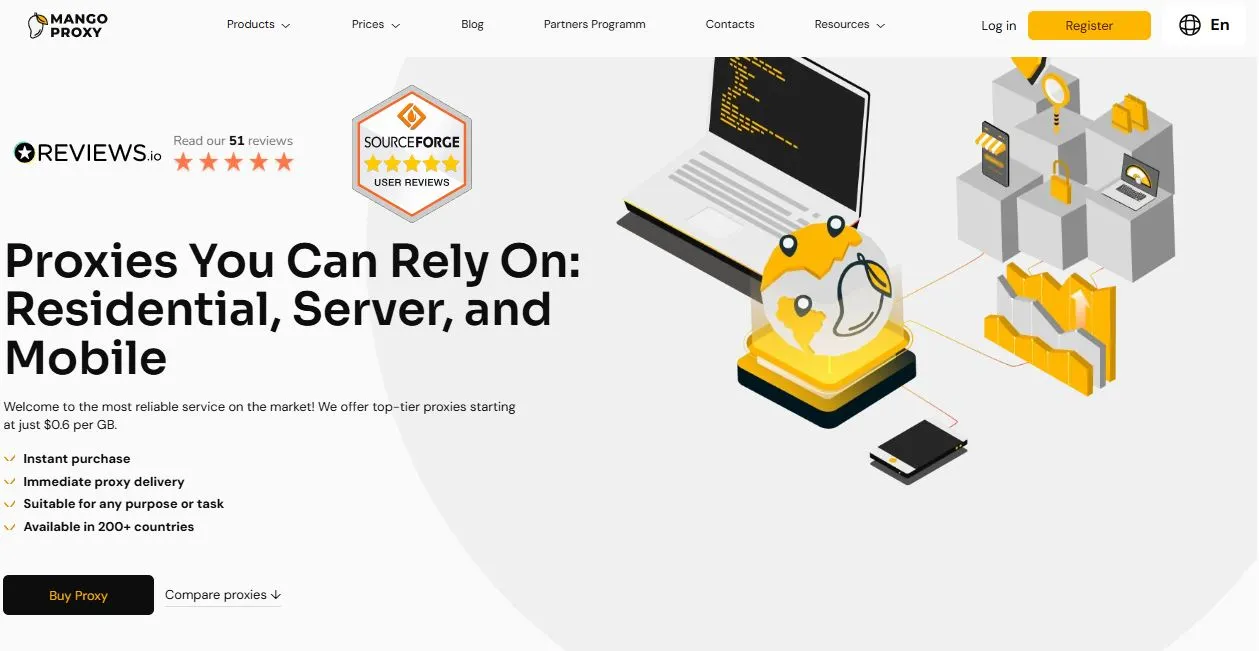
Seven proxy products, a residential pool of more than 90 million IPs, and a mobile IP you can rent for a single day at $9. MangoProxy is a proxy provider that sells rotating residential, Residential Light, dynamic datacenter, dynamic ISP, static datacenter, static ISP, and 4G/5G mobile proxies from one dashboard, with a public price table for every one of them. Rates start at $0.60 per GB for datacenter traffic, $0.99 per GB for Residential Light, $2 per GB for the full residential pool, and $1.43 per IP for static datacenter addresses. For this review we read all seven product pages, every pricing table, the locations page, and the support and payment details as published in October 2026. We did not run a speed benchmark, so each performance figure below is MangoProxy's own claim and is labelled that way. The short version: the range is wider than most mid-priced shops offer, the cheap tiers really are cheap, and a handful of numbers on the site disagree with each other in ways you should clear up with support before a large order.
Two scores in that card need explaining. Product Range gets 4.9 because few providers at this price put shared residential, a budget residential tier, rotating and static ISP, rotating and static datacenter, and two kinds of mobile behind a single login. Transparency gets 4.4, lower than you might expect from a company that publishes every price. The reason is small but real. MangoProxy quotes uptime as 99.9%, 99.94%, and roughly 99.95% on different pages, lists both 200+ and 220+ locations, and gives the Residential Light pool as 80 million on its product page and 85 million on its pricing page. None of that changes what you pay. It does tell you to read the headline numbers as round figures.
Why MangoProxy Is Worth a Closer Look
Seven Proxy Products, One Login
Residential, Residential Light, dynamic datacenter, dynamic ISP, static datacenter, static ISP, and mobile share one dashboard and one balance. Many shops at this price cover two or three of those.
90M+ Residential Pool, 200+ Countries
The full residential product targets by country, state, city, ASN, or ZIP code, with sticky sessions that hold for 30 to 40 minutes on average. That is finer targeting than many budget pools allow.
Residential Light from $0.99/GB
A second residential tier with country-level targeting only. It costs about half the full residential rate, so you stop paying for city and ASN filters you never switch on.
Mobile IPs Rented by the Day
A dedicated 4G/5G port starts at $9 for 24 hours on named carriers such as AT&T, T-Mobile, EE, and Orange. Handy for a one-off test before you commit to a $73 month.
HTTP(S), SOCKS5, and 450+ Integrations
Every product ships both protocols with login/password or IP-whitelist access. The integrations list covers antidetect browsers, trackers, and scraping tools, and a public API manages sub-users.
Six Free Network Tools
My IP, IP lookup, a proxy checker, a port scanner, IP trace, and a DNS leak test are open to anyone on the public site. Useful for confirming what a proxy exposes before real traffic goes through it.
What Does MangoProxy Sell? Seven Proxy Products Explained
MangoProxy's catalog splits into two billing models, and that split matters more than the product names. Four products bill by traffic and share a pool. Residential proxies (IPs borrowed from real home and mobile connections) draw on the 90M+ pool across 200+ countries, with targeting by country, state, city, ASN, or ZIP code and sticky sessions that hold for 30 to 40 minutes on average. Residential Light uses a pool of 80 to 85 million IPs with country-level targeting only, at roughly half the price. Dynamic ISP proxies (addresses registered to internet providers but hosted on servers) cover 70+ countries from a 500K+ pool at a listed 20 to 80 Mbps. Dynamic datacenter proxies are the cheapest line: 1M+ IPs in 50+ countries at up to 100 Mbps. How those IP classes trade off against each other is laid out in the ultimate guide to proxy services, and the residential category has its own residential proxy providers guide.
Three products bill per IP and come with unlimited traffic. Static datacenter proxies give you a fixed, private IPv4 address in one of 30+ countries on a 1 Gbps channel. Static ISP proxies do the same with an address that belongs to a consumer internet provider, so it reads as a home user while staying put for the whole rental, and targeting goes down to ASN level. Mobile proxies come in two versions. The pool version hands you one endpoint into 5M+ carrier IPs with rotation by API or timer, sold by the week, month, quarter, or year. The dedicated version rents a private 4G/5G port on a named carrier (AT&T and T-Mobile in the United States, EE and O2 in the United Kingdom, Orange and SFR in France) by the day, week, fortnight, or month, with UDP available through OpenVPN. Every product speaks HTTP(S) and SOCKS5.
One dashboard runs all seven. It shows usage statistics, lets you create sub-users, manages IP whitelists, and includes a connection-string generator so you don't have to assemble the host, port, and targeting flags by hand. A public API covers proxy-user management. MangoProxy also lists 450+ integrations, mostly antidetect browsers, trackers, and scraping tools. If you run browser profiles, the BitBrowser antidetect review and the best anti-detect browsers in 2026 roundup show where a proxy like this plugs in. Six free tools sit on the public site too: My IP, IP lookup, a proxy checker, a port scanner, IP trace, and a DNS leak test. One caveat on the checker: it only accepts static proxies, and the page warns that each check spends traffic from your plan.
How Much Does MangoProxy Cost in 2026?
Every MangoProxy price is public, which makes the math easy to check. Residential runs on 12 tiers: $3.30 per GB at 5GB (a $16.50 order), $3.20 at 10GB, $3.00 from 25GB, $2.80 from 50GB, $2.65 from 100GB, $2.45 from 200GB, $2.25 from 500GB, and $2.00 from 1TB, with custom quotes above 3TB. That curve is shallow. Buying 200 times more traffic lowers the rate by about 39%, so small buyers aren't punished much and large buyers don't get a dramatic break. Residential Light has six packages: 25GB at $1.45 per GB, 50GB at $1.39, 100GB at $1.29 ($129), 200GB at $1.19, 500GB at $1.09, and 1,000GB at $0.99 ($990). At 100GB, Light costs 51% less than the full residential product. One oddity we spotted: the 25GB Light card shows a total of $37.25, which works out to $1.49 per GB, four cents above the advertised $1.45.
Dynamic ISP costs $2.00 per GB up to 10GB, $1.50 from 50GB, $1.00 from 500GB, and $0.80 from 1TB. Dynamic datacenter costs $1.50, $1.20, $0.75, and $0.60 at the same four steps. The static lines price per IP for 30 days across six volume bands. Static ISP starts at $3.29 for 1 to 9 IPs and falls to $2.49 at 300 or more. Static datacenter starts at $1.90 and falls to $1.43, and a site banner in October 2026 offered 10% off that line with the promo code FLOW, which brings a single IP to $1.71. Mobile pool access starts at $18.90 per IP for 7 days, $43.90 for a month, $142.90 for three months, and $349.90 for a year. The annual plan works out to about $29 a month, a third less than paying monthly. As listed, though, the three-month starting price is $11.20 more than three separate months, so compare in the cart before you pick it. Dedicated mobile ports start at $9 for 24 hours, then $30 for 7 days, $55 for 14 days, and $73 for 30 days. For context on what the rest of the mobile market charges, see the ultimate mobile proxy guide and the best mobile proxies for social media roundup.
Residential Beginner
Residential Light
Static ISP
Dedicated Mobile
Two things stand out in those tables. First, the per-IP products change the math for heavy traffic. A static ISP address at $3.29 a month with unlimited traffic costs the same as roughly 1GB of entry-tier residential data, so any account that streams, uploads, or stays logged in all day is cheaper on a fixed IP. Second, Residential Light is the value pick for jobs that only need the right country. You give up state, city, ASN, and ZIP targeting plus the advanced rotation modes, and you pay about half. Payment is by bank card or cryptocurrency, and we saw no mention of PayPal on the pages we read. We also found no free trial advertised, so the cheapest real test is one static datacenter IP at $1.90 or a 24-hour mobile port at $9. Free lists like the ones in our free proxy list are fine for a quick experiment, but they won't tell you how a paid pool behaves on your target.
MangoProxy Performance and Coverage: Speed, Uptime, and Pool by Country
MangoProxy publishes a speed range for each product, which is more useful than a single "fast" claim. Residential and Residential Light are listed at 10 to 30 Mbps with a response time under 0.5 seconds. Dynamic ISP and static ISP are listed at 20 to 80 Mbps. Both datacenter lines claim up to 100 Mbps, and the static datacenter page mentions a 1 Gbps channel. Mobile is where the pages disagree: the comparison table says 2 to 5 Mbps, while the dedicated mobile page says 20 to 80 Mbps depending on the network. Uptime is quoted at 99.9% on most pages, with a 99.99% SLA reserved for custom enterprise plans. We haven't benchmarked any of this. Treat each figure as a starting point, the same caution the proxy security and best-practices guide applies to any published SLA, and run your own sample through the GoToProxy proxy checker before you scale.
Coverage is broad but uneven, and the locations page is candid enough to show it. Of the 90 million residential IPs, 36 million sit in Brazil. That's 40% of the pool in one country. The United States has 6.75 million (7.5%), Germany and Italy 4.05 million each, Russia 3.6 million, India 3.54 million, Vietnam 2.25 million, and the United Kingdom 1.8 million. Japan and Poland are listed at 180,000 each. If your targets are in Latin America, this pool is unusually deep. If they're in Japan, 180,000 IPs still works for rank checks or ad verification, but heavy rotation against one strict site will recycle addresses sooner. MangoProxy says it can add a missing country within a few hours on request, which we haven't tested.
MangoProxy residential pool by country
Published IP count and share of the 90M pool. Source: MangoProxy locations page, October 2026.
Who Should Use MangoProxy?
MangoProxy's own use-case pages lean toward affiliate marketing, scraping, SEO, and social media work, and the product mix fits those jobs. Web scraping and price monitoring is the clearest match: dynamic datacenter at $0.60 to $1.50 per GB for sites that don't block server IPs, Residential Light for sites that do but only care about country, and full residential when you need a specific city or ASN. Our best proxies for web scraping guide explains how to split traffic that way, and the top web scraping tools list covers the software side. SEO and SERP tracking rarely needs more than country targeting, so Light at $0.99 to $1.45 per GB is usually enough. Multi-account social media and ad work wants one stable identity per account, which points to static ISP at $3.29 per IP or a dedicated mobile port, a setup described step by step in the proxy use cases for social media automation guide. Telegram account management runs over the SOCKS5 support that ships with every product, a workflow covered in the Telegram expert accounts guide. Ad verification benefits from the city and ZIP targeting on the full residential pool. Who should look elsewhere? Teams that need audited compliance paperwork up front, and anyone who wants a scraper API or unblocker bundled in, since we found neither on the site. For those needs, the Bright Data alternatives roundup and the Bright Data vs Oxylabs vs Smartproxy comparison are better starting points.
MangoProxy Use Case Matrix
Web Scraping at Volume
Datacenter from $0.60/GB for open sites, Residential Light for country-gated ones, full residential when you need a city or ASN.
SEO & SERP Monitoring
Rank checks rarely need more than the right country, so Light at $0.99 to $1.45 per GB covers 200+ markets cheaply.
Multi-Account Social & Ads
One static ISP address ($3.29) or one dedicated mobile port per account keeps each login on a stable identity.
Marketplace Price Tracking
Country and city targeting shows the prices and stock a local shopper sees on Amazon, eBay, or Walmart listings.
Ad Verification
State, city, and ZIP targeting on the 90M+ pool lets you confirm which ad a given neighborhood is served.
Short Mobile Tests
A 24-hour carrier port for $9 suits app QA or a one-day campaign check without paying for a full month.
Support, Payments, and Policies
Support runs through email (support@mangoproxy.com) and a Telegram bot (@mangoproxy_bot), plus a contact form and a help center the site calls the Training Center. Hours are the unclear part. The footer gives a support window of 08:00 to 20:00 GMT+3, while the static proxy pages and several customer quotes say 24/7. If you work in US time zones, ask which one applies before you depend on it. The footer links an Ethical Use Policy, a Refund Policy, a Privacy Policy, and Terms of Service, and the site states a no-logs policy. Its FAQ includes two questions we'd read closely: "What is KYC and why is it needed?" and "What isn't available on dynamic proxies and why?" Both suggest that identity checks and some target restrictions apply. That's normal for residential pools, but it can surprise you mid-project. We couldn't see the answer text, so ask. MangoProxy says 530+ companies and 10,000+ customers use the service and points to user reviews on SourceForge. For a wider view of the category, our proxy services hub and the privacy tools section list the alternatives.
Pros & Cons
MANGOPROXY ANALYSIS
Advantages
Considerations
Is MangoProxy Worth It? Final Verdict for 2026
MangoProxy earns a 4.6 out of 5 from us. Its strength is range at a fair price: seven products, a public table for each, and entry points low enough to test without a sales call. One static datacenter IP costs $1.90, a day on a dedicated mobile port costs $9, and 5GB of full residential traffic costs $16.50. Residential Light is the standout for budget scraping and SEO work at $0.99 to $1.45 per GB, and static ISP at $2.49 to $3.29 per IP with unlimited traffic is priced well for account work. The weak spots are tidiness and depth. A few published figures contradict each other, support hours are unclear, the pool leans heavily toward Brazil, and there's no scraper API if you want one vendor for everything. So who should buy? Solo operators and small teams doing scraping, rank tracking, ad checks, or multi-account work in the Americas and Europe get a lot for the money. Enterprise buyers with compliance checklists should compare it against the names in our top proxy service providers list first. Start small, check the IPs on your real target with the GoToProxy proxy checker, and scale only after a week of clean results.
Test MangoProxy on a small plan first
Start with one static datacenter IP ($1.90), a 24-hour dedicated mobile port ($9), or the 5GB residential plan ($16.50) to check ASN, speed, and success rate on your own target. Promo code FLOW took 10% off static datacenter proxies when we checked in October 2026.