
ProxyLane Review 2026: 28M+ Residential Proxies Tested for Scraping
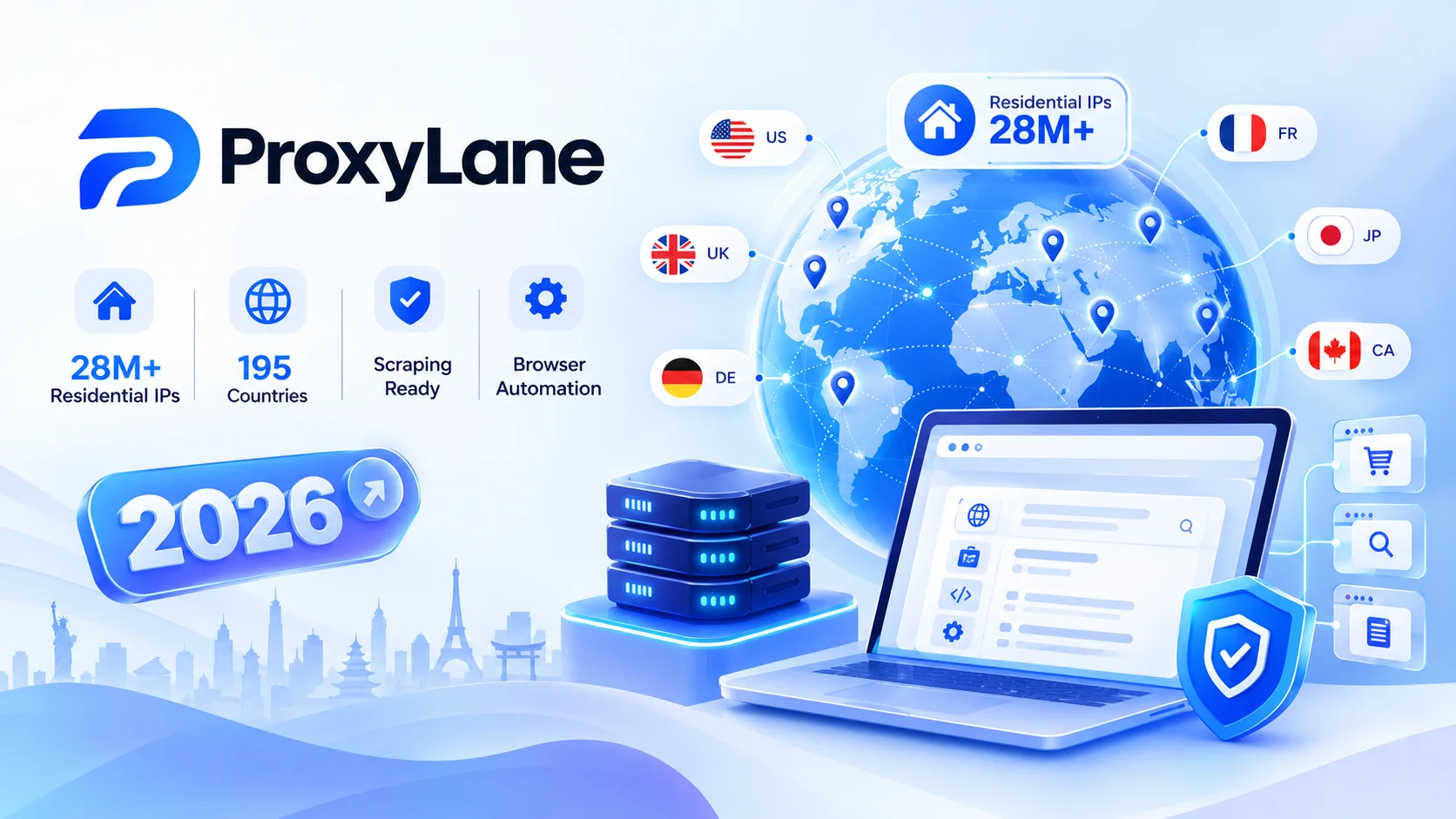
A 28-million-IP residential pool, unlimited concurrent connections, and a $1.95 trial that lets you point a real Playwright script at real target sites before you spend another dollar. That's the shape of ProxyLane, a residential proxy network built around scraping teams, browser-automation stacks, and location-based monitoring workflows. The dashboard sells one thing (rotating and sticky residential proxies), sells it on a pay-as-you-go model where traffic never expires, and pairs the network with five free connection tools plus a full Playwright and Python setup library.
After walking through the residential product page, the tiered pricing table, and the Use Cases block, the operator profile lands with a scraper-first pitch rather than the social-account-farming lean that dominates this category. Location targeting drills down to country, city, ISP, ASN, and ZIP where the pool supports it. Sessions can rotate per request or hold sticky for up to seven days while the exit device stays online. Whether that combination fits your specific workload is what this review is here to answer.

The Trial Access score reflects a specific strength of the ProxyLane story: 350 MB for $1.95 is one of the friendliest test-buy commitments in the residential category. Most residential networks either give a token free credit that runs out before you can point Playwright at anything real, or push you straight into a $50–$100 minimum. Paired with the "traffic never expires" model, that $1.95 lets you run a real batch against a real target market, sit on the remainder for a week while you review the data, and only commit to a larger tier once you have concrete numbers on success rate and GB-per-completed-task. No KYC at signup keeps the onboarding under a minute.
*Sticky sessions depend on the exit device remaining online, and are not a guaranteed fixed IP.
Why ProxyLane Is Worth a Closer Look
Unlimited Concurrent Connections
Every tier ships with no cap on parallel requests, so a Scrapy fleet, a Playwright grid, or an n8n batch can widen threads without a per-connection surcharge biting into the per-GB math.
Rotate Per Request or Sticky to 7 Days*
Independent requests can pull a fresh exit every call. Multi-step browser flows can hold the same IP for up to a week while the exit device stays online. *Not a guaranteed fixed IP.
Country, City, ISP, ASN, ZIP
Five geo dimensions of targeting where the pool supports them. Enough granularity to check a regional storefront, a local SERP, or an ASN-scored ad campaign without booking a second vendor.
HTTP, HTTPS & SOCKS5
Same credentials cover the three protocols that matter to Scrapy, Playwright, Puppeteer, Requests/httpx, and Telegram automation libraries. No custom SDK to bolt on top of your existing pipeline.
Traffic Never Expires
The GB you buy stays on the account until you burn it. A 25 GB Build plan paused for a month is still 25 GB when a client project restarts. Pay-as-you-go without a month-end reset.
24/7 Human Support, No KYC
Chat, email, Telegram, and Discord contact channels are staffed around the clock. Signup skips KYC entirely, so you can move from account creation to a first authenticated request in about 30 seconds.
ProxyLane's Product Range: Residential Proxies, Free Tools & MCP Access
ProxyLane sells one core product and wraps it with two support surfaces. The core product is rotating and sticky residential proxies drawn from a 28M+ IP pool spanning 195 countries. Location targeting narrows to country, city, ISP, ASN, and ZIP where the pool supports it. Rotation happens either per request (a fresh exit every call) or on a sticky basis for up to seven days while the exit device stays online.
Two things stand out on the product page. First, unlimited concurrent connections ship on every tier, which shifts the cost math for parallel scraping workloads: you're paying for GB and locations, not for connection slots. Second, the pool is described as ethically sourced with an ultra-low fraud score. For anyone comparing across the market, our definitive guide to residential proxy providers covers the shape of the field ProxyLane competes in.
The second surface is the free connection tools, five utilities that check your public IP, test a proxy string, and prepare settings before you burn trial GB. They sit alongside our own GoToProxy proxy checker as sanity-check gates before scaling. The third surface is MCP access, a planned interface for AI agents (Claude, Cursor, ChatGPT, or your own MCP-compatible client) to fetch public web pages through ProxyLane residential IPs.
MCP access is currently in an application flow rather than open self-serve, so treat it as a roadmap signal rather than an off-the-shelf feature. That said, the direction fits the broader shift toward agent-driven data collection: instead of writing another Scrapy spider, an agent posts a URL and a region, and the proxy layer handles the request boundary. Documentation, Playwright and n8n setup guides, and a full-content llms.txt for AI consumption round out the developer surface.
ProxyLane Pricing: Tiered GB Packages With Non-Expiring Traffic (2026)
Pricing on ProxyLane is published in full on the pricing page, which is more transparent than the "starting at" tables that plague this category. The Individual view shows four tiers: Trial at $1.95 for 350 MB, Explore at $6.50 for 1 GB ($6.50/GB), Build at $137 for 25 GB ($5.48/GB), and Run at $225 for 50 GB ($4.50/GB). A larger 1 TB commitment lands the effective rate at $2.50/GB, and Enterprise pricing starts from $2/GB for 5 TB+ packages.
The per-GB curve scales cleanly rather than in cliff steps, so the entry tier isn't overpriced to force an upgrade. Every tier includes the same 28M IP pool, the same country/city/ISP targeting, the same HTTP + SOCKS5 protocol support, and the same rotating/sticky session controls. What scales with tier size is the effective per-GB rate. Unused GB never expires, so a scraper team can buy Build ($137 / 25 GB), run three campaigns across two months, pause during a client offboarding week, and still have the same balance waiting when work resumes.
Trial
Explore
Build
Run
*Sticky sessions run for up to 7 days while the exit device remains online. They are not a guaranteed fixed IP.
Two details in the pricing table above are worth reading twice. First, the per-GB curve from $6.50 (1 GB) down to $2/GB (5 TB+) is a 3.25x reduction, larger than what most residential vendors quote on their public pages, which usually cap discounts at 2x. That matters if you're a scraping team whose GB usage is climbing month over month: the cost per successful request drops as you scale, without pushing you into a locked annual commitment.
Second, unused GB rolls forward with no month-end reset, which flips the usual scraping-vendor risk (buy 100 GB, use 60, lose 40 at month-end) into a straight budget tool. For a broader cost-per-successful-request framing across residential vendors, our ultimate guide to proxy services and top-5 proxy providers roundup cover the comparable pricing across the market. Payment covers Visa, Mastercard, Discover, American Express, Alipay, USDC, USDT, and 25+ other crypto assets: a payment surface wider than most Western-focused proxy shops publish.
ProxyLane Performance: Response Time, IP Quality & QUIC Transport
ProxyLane publishes a ~0.35-second average response time on residential IPs, powered by a QUIC transport layer between the client and the gateway, plus an "ultra-low IP fraud score" claim tied to ethically sourced real devices. We didn't run a controlled multi-week benchmark against those numbers for this review, so treat them as starting figures pending your own tests, the same caution our proxy security and best-practices guide applies to any published SLA. What can be said from the surface walkthrough: the $1.95 trial is the right way to verify both numbers against your target sites, and the GoToProxy proxy checker can validate the ASN and geo of a live ProxyLane port before you scale a workload up.
Two figures matter most when you run your own tests: real success rate on a specific target (what percentage of requests return the page or the data you asked for, without CAPTCHA or block) and effective GB per completed task (once you factor retries, session churn, and rendered-page overhead). Both are workload-specific, and both are what will decide whether the 4.50/GB Run tier or a 5 TB Enterprise commitment pays off for your team.
On the sticky session side, one caveat that's rare to see stated so clearly on a vendor page: ProxyLane calls out that sticky mode holds one IP while the residential exit device stays online, not as a permanent fixed IP. That framing is honest, and it matches how real residential networks work: the exit is somebody's phone, laptop, or home router, and their device going offline ends your session.
Plan for that in your automation: catch the exit change, refresh the session, and continue. The same pattern applies to social-account and Telegram workflows discussed in our proxies in Telegram expert accounts guide, and it's a healthier framing than the "dedicated static residential" claims some competitors publish. Sticky sessions extend to 7 days on the higher tiers, subject to that device availability. GDPR and CCPA compliance are called out on the pricing page, which matches what EU and California-based buyers should be checking for on any residential vendor.
Who Should Use ProxyLane
ProxyLane's use-case pitch is scraper-first, and the product design reflects that priority. Web scraping at scale is the primary fit: unlimited concurrent connections mean a Scrapy fleet or a headless Chrome grid can fan out threads without hitting a per-slot cap. Country/city/ISP/ASN/ZIP targeting covers the geo dimensions that anti-bot systems key on. Rotating IPs per request suits independent page fetches. Sticky sessions up to seven days suit multi-step flows: sign in, browse, extract, export.
Our best proxies for web scraping guide and top web scraping tools roundup cover the workload patterns ProxyLane is built around. Browser automation (Playwright, Puppeteer, Selenium) is the second fit: sticky mode holds session identity across a multi-step task while the exit device stays online, and the HTTP + SOCKS5 protocol pair covers every browser client in the wild. Ecommerce price and stock monitoring is a strong third fit: city and ISP targeting reads the local storefront a real shopper would see, and the reusable proxy lists in the dashboard let you save per-market settings and hit them on a schedule. For cross-referencing against alternatives in the space, our Bright Data alternatives article and Bright Data vs Oxylabs vs Smartproxy comparison map the wider vendor landscape.
Beyond the primary scraping and browser automation fits, ProxyLane covers three secondary workloads. Media buying (Meta, Google Ads, TikTok campaign management across multiple accounts) benefits from sticky sessions per browser profile, so each ad account holds a stable IP for the length of a working session rather than rotating out mid-flow.
Pair it with an antidetect browser like the one covered in our BitBrowser setup guide or one of the picks from the best anti-detect browsers in 2026 roundup, and each profile gets a matching fingerprint plus a matching IP. Digital agencies managing client accounts across Reddit, X, and LinkedIn can save one proxy list per client project, hand off the settings to a team member's profile manager, and keep account access separated. SEO and ad verification teams pull local SERPs, check regional landing pages, and confirm that geo-targeted ads render for real users in the target market. The pattern for social-heavy accounts overlaps with our proxy use cases for social media automation guide and the mobile-first workflow patterns in the best mobile proxies for social media management roundup.
ProxyLane Use Case Matrix
Web Scraping at Scale
Unlimited concurrent connections plus per-request IP rotation fit Scrapy, Playwright, and n8n batch runs. Country/city/ISP/ASN/ZIP targeting covers the geo dimensions anti-bot systems read.
Browser Automation
Sticky sessions up to 7 days hold IP continuity across sign-in, navigation, and export steps. HTTP + SOCKS5 support covers Playwright, Puppeteer, and Selenium natively.
Ecommerce Price & Stock Monitoring
City and ISP targeting returns the local storefront a real shopper sees. Reusable proxy lists save per-market settings for scheduled monitoring runs.
Media Buying (Multi-Account)
Sticky sessions per browser profile keep each Meta/Google/TikTok ad account on a stable IP through a working session. Pair with antidetect fingerprints for full stack separation.
Digital Agency Operations
Save one proxy list per client project on Reddit, X, or LinkedIn. Larger packages cut the per-GB rate as the roster grows, without pushing you into an annual commitment.
SEO & Ad Verification
Country-level residential rotation pulls local SERPs and regional landing pages. Check that a campaign renders for real users in the market it targets before you spend more on ads.
Support, Compliance & Dashboard
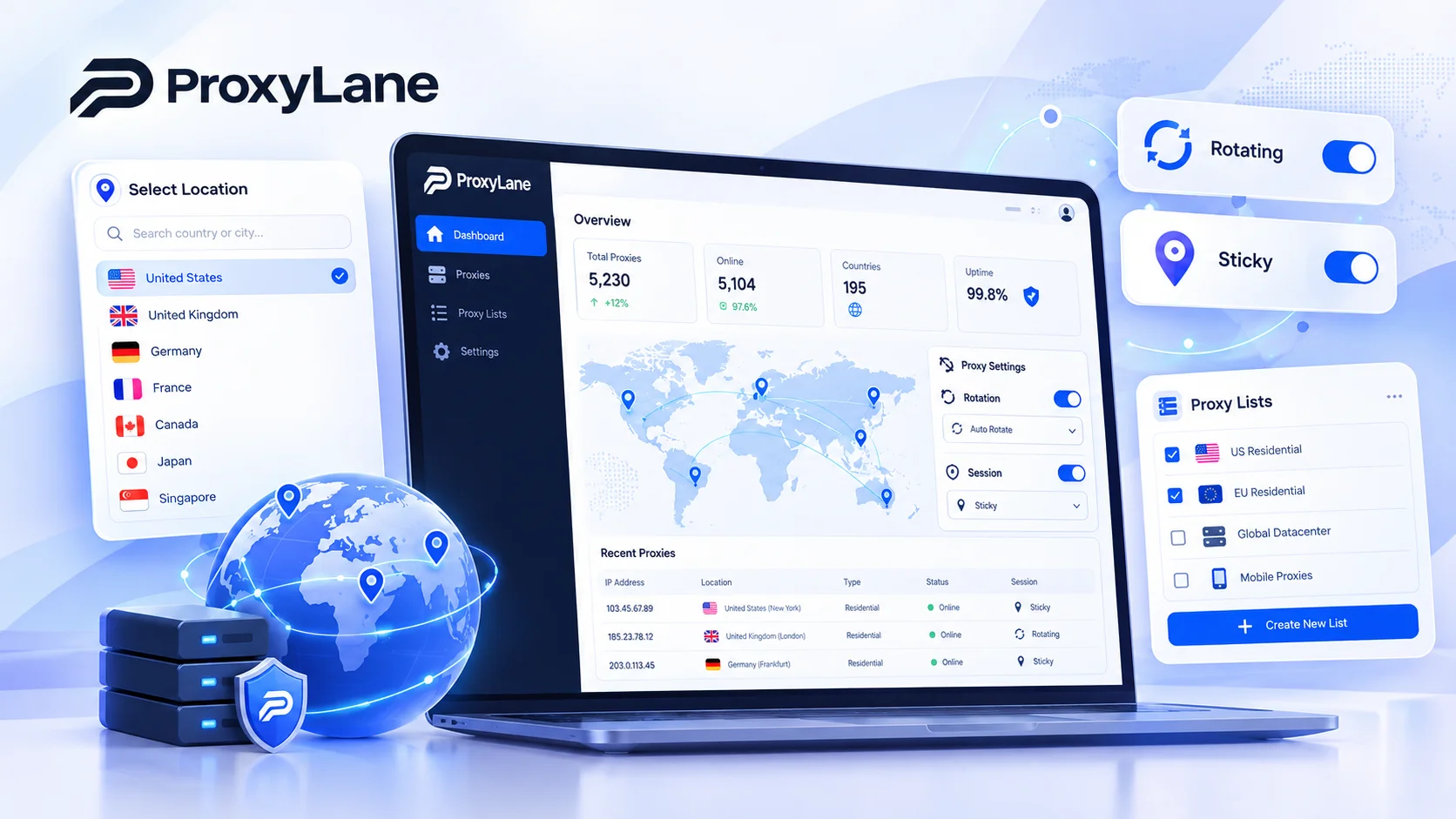
Support runs across four channels: in-app chat, email, a Telegram support handle (@proxylane_support), and a Discord server. All four are staffed 24/7 with human agents rather than a chatbot triage layer. That's a wider surface than most mid-market residential vendors publish, and for scraping teams whose jobs fail at 3 AM on a Sunday it changes the recovery time from "next business day" to "in the next hour." The dashboard covers the standard controls: bandwidth usage tracking with a daily-usage view, per-project reusable proxy lists you can export, country/city/ISP selection at request time, rotating vs sticky mode toggle, and connection testing.
Compliance is GDPR and CCPA covered on the pricing and residential product pages. Enterprise buyers with procurement checklists that require independent audit paperwork (SOC 2, ISO 27001) should still request those artifacts directly. Payment covers Visa, Mastercard, Discover, American Express, Alipay, USDC, USDT, and 25+ other crypto assets, which spans nearly every payment rail a global buyer might need.
Pros & Cons
PROXYLANE ANALYSIS
Advantages
Considerations
Final Verdict: ProxyLane Review 2026
So, is ProxyLane worth buying from? For scraping teams, browser-automation stacks, and ecommerce monitoring workflows that want a residential pool built around their tooling rather than around social-account farming, the answer is yes. Unlimited concurrent connections remove the per-slot ceiling that hurts parallel jobs on many competing vendors. Sticky sessions up to seven days (subject to device availability) hold IP continuity across multi-step browser flows without pretending to be a static fixed IP. Country, city, ISP, ASN, and ZIP targeting covers the geo dimensions that matter for local SERP tracking and regional storefront monitoring.
The per-GB curve from $6.50 (1 GB) down to $2/GB (5 TB+) is a 3.25x reduction that rewards volume, and unused GB never expires, so a paused project doesn't burn budget. The $1.95 trial with no KYC is the right way to verify success rate and GB-per-completed-task on your own targets before scaling. Enterprise procurement buyers will want to ask about SOC 2 or ISO 27001 paperwork directly, and social-account operators who need static residential ASNs for a single account per IP should pair ProxyLane residential with a separate ISP proxy vendor.
For everyone else running scraping, browser automation, price monitoring, and SERP verification, ProxyLane earns a spot on the shortlist alongside the names in our definitive residential proxy providers guide. Run the 350 MB trial through the GoToProxy proxy checker against your target geo, measure success rate and GB per successful task on your real workload, and you'll have concrete numbers to size the next purchase within a week.
Try ProxyLane on your real workload for $1.95
350 MB is enough to point Playwright, Scrapy, or n8n at real target sites and measure success rate plus GB-per-completed-task on your actual data. No KYC, and unused GB never expires. Once the numbers hold, size the next purchase from real use rather than guesswork.
Frequently Asked Questions