Proxy Legality by Country (2026): Is It Legal? 7 Providers With Clear Rules
Proxy Legality by Country (2026): Is It Legal? 7 Providers With Clear Rules
Most people ask whether proxies are legal and stop at yes or no. The better question is what you do through them, where you are, and what your provider allows. In 4 countries checked, the rules bite on use, not ownership. Here’s proxy legality by country, then 7 providers ranked on their written rules. GoToProxy earns a commission on some links here at no extra cost to you.
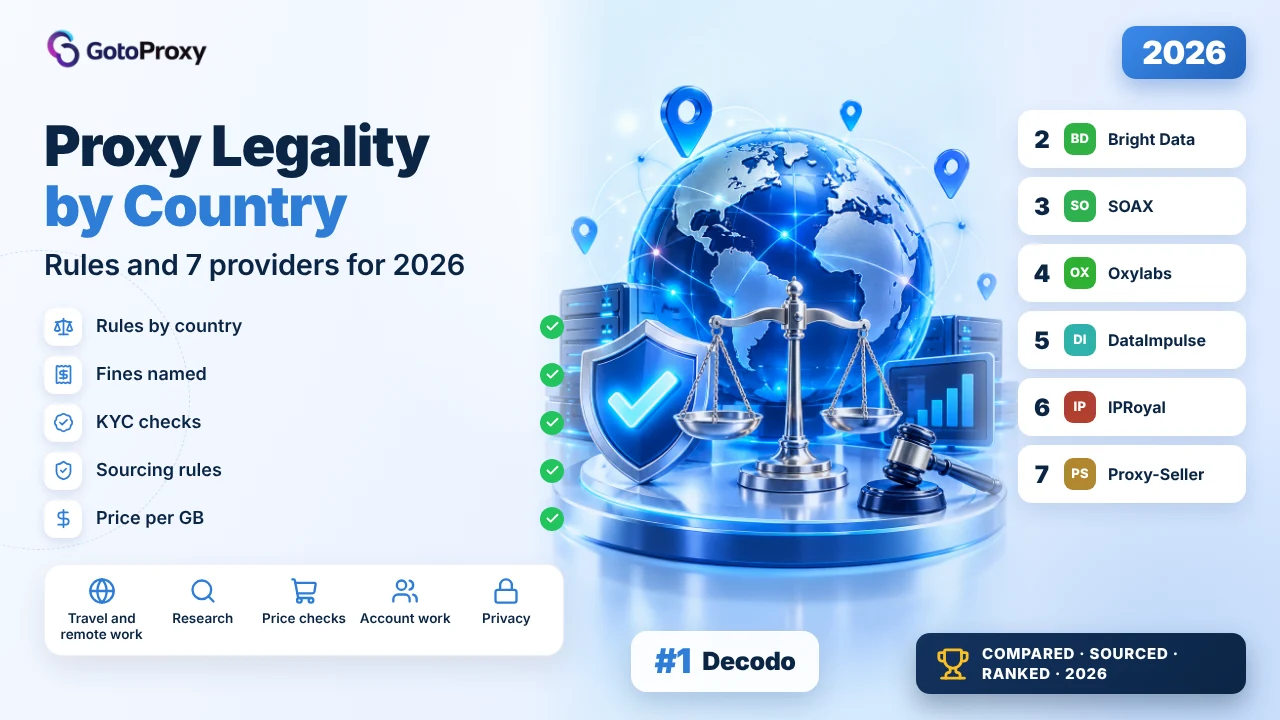
Using a proxy isn’t banned outright in most countries; the laws in this check target what you do through one. China requires approval for cross-border VPN channels, Russia fines searching for extremist material, including via VPN, at 3,000 to 5,000 roubles, Iran bans VPNs without a permit, and the UAE fines IP circumvention to commit or hide a crime up to Dh2 million.
- 4 countries, 4 kinds of rule: China needs approval, Iran needs a permit, Russia fines searches and VPN ads, and the UAE punishes hiding a crime behind another IP.
- Provider rules matter too: Bright Data allows residential access only after manual KYC for companies, and Oxylabs and Decodo block banking, government and streaming targets for most users.
- Best overall: Decodo. It publishes consent and pay terms for peers, holds an EWDCI certification, checks every new customer and offers a 3-day trial.
Is using a proxy legal?
In most countries, yes: the laws in this check punish what a proxy is used for, not the proxy itself. 4 countries go further. China, Russia, Iran and the UAE each restrict tools that change or hide your connection, and each in a different way. This is a summary of published sources, not legal advice.
| Country | What the rule covers | Penalty named | Source |
|---|---|---|---|
| China | Cross-border VPN channels need MIIT approval (January 2017 notice); only licensed telecom operators’ VPNs are described as legal | Not stated; a company was fined in May 2019 for illegal proxy software | AllBright Law via law.asia |
| Russia | Fines for deliberately searching extremist material, including via VPN; VPN advertising banned; VPN use an aggravating circumstance in crimes; in force from 1 September 2025 | 3,000 to 5,000 roubles for searches; up to 500,000 roubles for VPN ads by companies | Human Rights Watch; OVD-Info |
| Iran | VPN use banned without a legal permit (resolution of 20 February 2024) | Not specified in the report | TechRadar |
| UAE | Circumventing an IP address to commit an offence or prevent its discovery (Decree-Law No. 34 of 2021, Article 10) | Temporary jail and/or Dh500,000 to Dh2 million | Gulf News |
Sources read on October 30, 2026. Laws change; check the current text or a local lawyer before you rely on this table.
Most of these rules name VPNs, but they describe the same act a proxy performs: routing your traffic through another address. The AllBright note on China even cites a fine for illegal proxy software. If you’re inside one of these countries, treat a proxy like a VPN until a lawyer says otherwise. Our best proxies in UAE guide covers the UAE rule in more detail.
The proxy is rarely the offence. What you do through it, and where, decides the risk.
Why do provider rules matter as much as the law?
Because a provider can cut you off long before any court is involved. 6 of the 7 providers here mention KYC on the pages read, 3 publish blocked targets, and all of them can suspend accounts. Reading those rules before buying saves money you’d lose on a blocked plan.
- KYC gates: Bright Data requires manual KYC for residential access, and IPRoyal unlocks its full pool only after ID checks via iDenfy.
- Blocked targets: Oxylabs lists 8 restricted categories and Decodo 7, including banking, government sites and streaming services.
- Suspension without refund: IPRoyal says banned activities lead to immediate suspension without recourse; Proxy-Seller may end access at its discretion.
- Law enforcement: IPRoyal states it cooperates with law enforcement requests, so a proxy is not a shield for unlawful activity.
- Sourcing ethics: Decodo and SOAX publish consent rules for the people whose devices carry your traffic; four providers here published none on the pages read.
How do you use proxies legally?
Check three layers before your first request: the law where you are, the terms of the site you’re visiting, and your provider’s rules. Most legal trouble with proxies comes from the second and third layers, not the first, and each takes minutes to read.
- Check your own countryIf you’re in China, Russia, Iran or the UAE, read the rule in the table above and get local advice before using any proxy or VPN.
- Read the target site’s termsScraping or account rules on the site you visit can matter more than proxy law, especially for logged-in pages.
- Complete the provider’s KYCDo it before you need the traffic. Bright Data’s review can take 48 hours after you finish, and it needs a company.
- Stay inside your approved useBright Data blocks traffic outside the use case it approved; other providers suspend accounts that drift.
- Handle personal data carefullyIf pages contain personal data, collect only what you need and check data protection rules such as the GDPR in the EU.
- Keep recordsSave your KYC approval, the use case you declared and the terms version you accepted, in case a provider asks.
Want to see a provider’s IP before you commit? Use our proxy checker, or compare more options on our proxy providers hub.
Law, site terms, provider rules: read all three, in that order.
Which proxy providers have the clearest legal rules in 2026?

Decodo wins because it publishes the most complete rulebook of the seven. Its ethics page says peers give explicit consent and earn money per GB shared, it is a co-founder of the Ethical Web Data Collection Initiative with an EWDCI Certified label, and every new customer goes through KYC and an anti-fraud check. Entry price: $3.75 per GB.

Buying question one, is it clean? The page says Decodo works only with providers that verify their peers and that peers have full control over sharing. It commits to GDPR and CCPA compliance. That is 4 written commitments, more than any other provider here published on the pages read.
Buying question two, what’s blocked? Most targets in 7 categories are restricted for most users: banking and finance, government, streaming, the Apple and Google stores, ticketing, gaming and mailing. If your job sits in one of those, ask before buying, because the trial won’t open them.
Buying question three, what does it cost to check? A 3-day trial with 100MB, then 3 GB for $11.25 a month. The 14-day money-back covers eligible subscriptions, not trial usage. Flagged accounts must pass an ID check, and rejected customers get the reason by email.
- Co-founder of EWDCI, holds EWDCI Certified label
- Explicit peer consent, peers paid per GB shared
- KYC plus anti-fraud check for new customers
- 7 target categories mostly restricted
- 3 GB for $11.25 ($3.75 per GB); 3-day trial
- Teams that must show a sourcing policy
- First-time buyers who want a trial
- GDPR or CCPA-minded projects
- Most complete sourcing statement
- Industry certification named
- Trial plus money-back
- Rejection reasons sent by email
- 7 target categories mostly blocked
- Money-back excludes trial usage
- ID check if your account is flagged
| Plan | Price | What you get | Per GB |
|---|---|---|---|
| Trial | Free | 3 days, 100MB | n/a |
| 3 GB | $11.25 a month | 3 GB | $3.75 |
| 100 GB | $275 a month | 100 GB | $2.75 |
| Pay as you go | $4 per GB | No commitment | $4.00 |
The ethics page lists restricted categories but no full list of prohibited activities; it says use must be lawful and legitimate. It names no individual partner networks behind the pool.
Verdict: Best for buyers who need written sourcing and customer rules; not ideal for banking, streaming or ticketing targets. Read the full Decodo review →

Bright Data runs the strictest gate. Its docs say there is no automatic, instant or self-serve path to the residential network: every request gets a manual KYC review, only registered companies with a corporate email qualify, and personal or hobby projects aren’t approved. Pricing is $4 per GB under a 3-month promo, $8 list.
Buying question one, can you get in? Since July 7, 2026, KYC applies to all new residential zones. You add funds, submit a form with a company registration document, and may face an ID check or a video call. The docs say a decision follows within 48 hours of completing the process.
Buying question two, what’s blocked? Government websites are blocked on all networks, traffic outside your approved use case returns an Access denied error, and residential traffic is monitored around the clock against the acceptable use policy. That is the tightest set of rules among the seven.
If KYC is a blocker, the docs point to ISP proxies, datacenter proxies or the Web Unlocker API, none of which require it. Freelancers and solo users should start there, or pick another provider for residential traffic.
- No self-serve residential access; manual KYC
- Company email and registration document required
- KYC for residential zones created after July 7, 2026
- Government websites blocked on all networks
- Residential $4 per GB promo, $8 list
- Registered companies with a clear use case
- Teams that need an audit trail
- Enterprises that want strict screening
- Strictest written access rules
- Decision within 48 hours of KYC
- 24/7 traffic monitoring
- Alternatives without KYC listed
- No residential access for individuals
- KYC needs funds added first
- Sourcing statement not on the pages read
| Plan | Price | What you get | Per GB |
|---|---|---|---|
| Pay as you go | $4 per GB (promo) | Residential, after KYC | $4.00 |
| $499 a month | $499 | 141 GB | $4.00 listed |
| $999 a month | $999 | 332 GB | $3.00 listed |
| ISP or datacenter | Per IP | No KYC needed | Per IP |
KYC isn’t available in Playground or Limited Trial modes, so the free trial and residential KYC don’t overlap on the pages read. Zones created on or before July 7, 2026 keep working.
Verdict: Best for companies that want the strictest screening; not ideal for individuals or quick tests. Read the full Bright Data review →

SOAX states the simplest rule of all: it verifies the identity of every client who uses its proxies. Its ethical guidelines add that all peers have consented, are informed of their rights, can opt out, and route traffic only when their devices are idle. The catch: no residential price appears on its location pages.
Buying question one, is it clean? Consent, opt-out and idle-only routing are 3 written rules. The page shows GDPR and CCPA badges and says SOAX is fully GDPR-compliant. It doesn’t describe how peers are rewarded, and it names no industry certification.
Buying question two, where can you use it? SOAX keeps a list of allowed use cases, monitors activity, and cuts access at once for suspicious accounts. Its location pages also say residential and mobile proxies are unavailable in the State of Texas, a rare written geographic restriction.
Buying question three, how much? The Morocco and UAE pages show no price, only a link to pricing. On October 28 the residential page showed $3 per GB for its US tier. There’s no free trial, only a free Sandbox account without credits.
- Verifies the identity of every client
- Peers consent, can opt out, used only when idle
- List of allowed use cases; no malicious use
- Residential and mobile unavailable in Texas
- GDPR and CCPA badges
- Teams that want verified-only neighbours
- Mobile and residential work outside Texas
- Buyers who can wait for a quote
- Every client verified
- Consent and idle-only rules
- Written allowed-use list
- Immediate cutoff for abuse
- No price on the pages read
- No free trial
- Unavailable in Texas
| Plan | Price | What you get | Per GB |
|---|---|---|---|
| Sandbox | Free | Account without credits | n/a |
| Credits | 1 credit = $1 | Residential and mobile | Rate by tier |
| US tier example | $200 plan plus $100 credit | 100 GB a month | $3.00 |
The guidelines link to a KYC and KYB policy whose contents weren’t on the page read. Location pages say no free trial in the FAQ but start your trial in a button.
Verdict: Best for buyers who want every customer verified; not ideal if you need a price before signing up or work in Texas. Read the full SOAX review →

Oxylabs publishes the clearest list of what you can’t reach. Its developer docs name 8 restricted categories with examples, from Netflix and PayPal to usa.gov and Ticketmaster, and say some targets can be enabled after a short KYC procedure. Its location pages show ISO 27001 certification and cyber insurance. Small buys cost $6 per GB.
Buying question one, what’s blocked? Entertainment and streaming, banking, government sites, gaming, ticketing, mailing, ads such as Google Tag Manager, and even IP-checking websites. Oxylabs gives you its own ip.oxylabs.io for checks instead. Ask support before buying if your target fits a category.
Buying question two, is it covered? The Morocco page shows certification images for ISO 27001, ISO 50001, ISO 14001, NIST and ANSI/TIA-942-B, and says all products carry Technology Errors and Omissions and Cyber Insurance. No sourcing statement was on the pages read.
Buying question three, how much? $6 per GB up to 5 GB, $2.50 from 1,000 GB on the residential page, but $8 per GB on its Morocco and UAE pages. A $5 welcome credit covers a first test.
- 8 restricted target categories with examples
- Some targets unlocked by a short KYC
- IP-checking sites blocked; ip.oxylabs.io offered
- ISO 27001 and other certification images
- Technology E&O and Cyber Insurance on all products
- Teams that need a clear block list
- Buyers who want certifications on paper
- Large scraping jobs at volume
- Clearest restricted-target list
- KYC only where needed
- Certifications and insurance shown
- $5 credit to test
- $6 to $8 per GB on small buys
- IP-checking sites blocked
- No sourcing statement on pages read
| Plan | Price | What you get | Per GB |
|---|---|---|---|
| Up to 5 GB | $6 per GB | Residential page | $6.00 |
| 1,000 GB and up | $2.50 per GB | Residential page | $2.50 |
| Country pages | From $8 per GB | Morocco and UAE pages | $8.00 |
Residential pages and country pages quote different starting prices, $6 and $8 per GB. The restricted list says it includes but is not limited to the categories shown.
Verdict: Best for buyers who want a clear block list before paying; not ideal for small budgets. Read the full Oxylabs review →

DataImpulse is the cheapest of the seven at $1 per GB, and its blog says its network is consent-based: IPs come from real users who knowingly opted in to share idle bandwidth for value, with a clear opt-out, not from malware or hidden bundling. The weakness for this list: the page read doesn’t describe customer KYC or prohibited uses.

Buying question one, is it clean? The sourcing claim is clear and the blog calls the pool GDPR-aligned. It doesn’t name an SDK, partner apps or what reward users receive, so you’re relying on one paragraph of self-description rather than a policy page.
Buying question two, what are the rules for you? The blog article doesn’t cover KYC or banned uses; its footer links to terms of service and a Report Abuse page. Read the terms before you buy if your use case is sensitive.
Buying question three, how much? $1 per GB, 5 GB for $5 for new customers, and gigabytes that never expire. City, ZIP and ASN targeting cost 2x the basic price. The residential page lists a 7-day refund policy.
- $1 per GB; 5 GB for $5 for new customers
- Consent-based pool with opt-out, as stated
- Not from malware or hidden bundling, as stated
- KYC and prohibited uses not on the page read
- Unused gigabytes never expire
- Budget country-level scraping
- Slow, irregular usage
- Buyers comfortable reading terms themselves
- Lowest price here
- Clear consent claim
- Traffic never expires
- 7-day refund policy
- No KYC described on the page read
- No sourcing details beyond one paragraph
- Targeting below country level costs 2x
| Plan | Price | What you get | Per GB |
|---|---|---|---|
| Intro | $5, once | 5 GB, new customers | $1.00 |
| Basic | $50 | 50 GB | $1.00 |
| Advanced | $800 | 1 TB | $0.80 |
The sourcing statement comes from a DataImpulse blog post, not a policy page. The post’s legal FAQ is general industry guidance rather than DataImpulse’s own rules.
Verdict: Best for low-cost lawful scraping; not ideal if you need a provider with written customer checks.

IPRoyal is the most workable choice for individuals. Its KYC document lets you buy before verifying; identity checks with live photos and government ID, run by iDenfy, unlock the full residential pool, the API, sub-users and unrestricted targets. Risky uses are reviewed by hand rather than banned outright. The catch: 1 GB costs $7.

Buying question one, what’s blocked before you verify? Unverified customers face restrictions on targets and pool size, and risky targets are blocked by default. Verification can include business registration details if you buy as a company. Identity data is kept confidential and not shared with other third parties, the document says.
Buying question two, what gets you banned? DDoS attacks, spam, brute force and impersonation lead to immediate suspension without recourse. IPRoyal says it may suspend service, send a questionnaire, and cooperates with law enforcement requests. The KYC document shows no date.
Buying question three, how much? $7 per GB for 1 GB on subscription, $5.25 at 10 GB, $1.75 from 10 TB. Traffic never expires, and sticky sessions last up to 7 days.
- Purchase allowed before identity verification
- ID and live photo checks via iDenfy
- Verification unlocks full pool, API and all sites
- Risky uses reviewed manually
- 1 GB $7; traffic never expires
- Individuals and freelancers
- Small first purchases
- Account work with long sessions
- No company needed to start
- Clear list of what KYC unlocks
- Manual review for grey-area uses
- Traffic never expires
- $7 per GB at 1 GB
- Restricted pool until verified
- KYC document undated
| Plan | Price | What you get | Per GB |
|---|---|---|---|
| 1 GB | $7.00 | Subscription; $7.35 pay as you go | $7.00 |
| 10 GB | $52.50 | Subscription | $5.25 |
| 10 TB and up | Quote | Custom | $1.75 |
The KYC document has no publication date, and its acceptable use policy is a separate page that wasn’t read. No sourcing statement was on the pages read.
Verdict: Best for individuals who verify only when they need more; not ideal for cheap small buys. Read the full IPRoyal review →

Proxy-Seller’s public offer is plain about what’s banned: anything that breaks applicable or international law, spam, phishing and internet fraud. Legal-entity customers must pass its KYC policy, and it can ask any customer for extra KYC through a third party such as Sumsub. Its residential Test plan costs $3.5 per GB.

Buying question one, which law applies? The offer sets Cyprus law as the governing law and requires you to follow all applicable laws. It doesn’t address the laws of your own country, so the country checks in this article still apply to you.
Buying question two, what happens if something goes wrong? Proxy-Seller may suspend or end access to your account at its discretion or if it decides you broke the agreement. The refund window is 24 hours for a refund or free replacement.
The weakness for this list: no sourcing statement appeared on the pages read, and the offer shows no effective date. Code GOTO15OFF works at checkout through our partner link.
- Terms ban illegal use, spam, phishing and fraud
- KYC required for legal-entity customers
- Extra KYC possible via third parties such as Sumsub
- Governing law: Cyprus
- Residential Test plan $3.5 per GB, valid 30 days
- Short paid tests
- Companies used to contract terms
- Buyers who want a coupon
- Clear list of banned activities
- Low-cost Test plan
- Fast delivery
- Coupon code
- No sourcing statement on pages read
- 24-hour refund window
- Terms undated
| Plan | Price | What you get | Per GB |
|---|---|---|---|
| Test it out | $3.5 per GB | Valid 30 days | $3.50 |
| Volume | From $1.45 per GB | Valid 30 days | From $1.45 |
| Enterprise | Custom | Custom | From $0.30 |
The public offer has no effective date; the only date is the footer copyright, 2014 to 2026. Sourcing and peer consent weren’t covered on the pages read.
Verdict: Best for cheap short tests under clear terms; not ideal if you need a written sourcing policy. Read the full Proxy-Seller review →
What do the fines and prices look like side by side?
These bars put the published numbers next to each other. Fines use the currency conversions given by each source. Prices are each provider’s own entry rates. Nobody here ran a test.
Figures are the ones each provider publishes, checked on October 30, 2026. They are advertised numbers, not test results.
How do the 7 providers compare on rules and price?
One table, the same rows for every provider, in ranking order. Bold marks a clear plus. Every cell comes from the provider’s own pages, read on October 28 and 30, 2026.
| Decodo Top | Bright Data | SOAX | Oxylabs | DataImpulse | IPRoyal | Proxy-Seller | |
|---|---|---|---|---|---|---|---|
| Customer KYC | KYC plus anti-fraud check | Manual KYC, companies only | Every client verified | Short KYC for some targets | Not on page read | ID checks unlock full pool | KYC for legal entities |
| Sourcing statement | Consent, paid per GB, EWDCI | Not on pages read | Consent, opt-out, idle only | Not on pages read | Opt-in with opt-out (blog) | Not on pages read | Not on pages read |
| Blocked targets published | 7 categories | Government plus use-case limits | Allowed-use list | 8 categories with examples | Not on page read | Risky targets blocked by default | Illegal uses, spam, phishing |
| Entry price | $3.75 per GB | $4 per GB promo | Not listed | $6 per GB | $1 per GB | $7 for 1 GB | $3.5 per GB Test |
| Trial or refund | 3-day trial, 14-day money-back | Free trial, no KYC in trial | No free trial | $5 credit | 7-day refund | Not listed | 24-hour refund |
| Individuals can buy residential | Yes, after checks | No, companies only | Yes, after verification | Yes | Yes | Yes, verify later | Yes; KYC for companies |
Which rules apply to you?
Four layers of rules sit on every proxy request. Each one can stop you, and each is read in a different place.
Proxy legality by country: your questions
I read four legal sources on October 30, 2026, Gulf News, Human Rights Watch, OVD-Info and TechRadar, plus an AllBright Law note on law.asia, and each provider’s compliance, KYC or terms page. Prices come from pages read on October 28. Scores weight customer rules 30%, sourcing 25%, price 20%, trial 15% and block-list clarity 10%. See independent proxy ratings on ProxyRates. Scores are our editorial rating built from published prices, features and terms. They are not lab measurements.